Notícias

  1. Home
  2. / Notícias
Why 48V Architecture? (Key Benefits) The 48V architecture’s core principle is to’ increase voltage while maintaining power output to reduce current’, delivering a series of key advantages: 1.High efficiency, low loss: According to the DC power formula P = V × I, when the power remains constant, the voltage increases fourfold (from 12V to 48V), while the current decreases to one-fourth of its original value. According to Joule’s law, the heat loss in a wire (P_loss = I² × R) is proportional to the square of the current. When the current is reduced to one-fourth, the line loss decreases to one-sixteenth of the original, significantly improving energy efficiency. Lightweight and low-cost: Smaller currents mean thinner wires (with smaller cross-sectional areas) can be used. This directly reduces the weight of the system’s cables and material costs, which is crucial for weight-sensitive fields such as automotive and robotics. 3.High power density: For robotic devices, smaller motors and thinner cables enable more compact and lightweight joint designs, enhancing both flexibility and integration. Security and Inheritance: 48V serves as the maximum safe voltage in typical applications, eliminating the need for stringent electrical safety measures and thus reducing system complexity and costs. It is a natural evolution of existing low-voltage systems (12V/24V), maintaining technical continuity (with lead-acid batteries rated in multiples of 6V). Review of the Development History of 48V Architecture Development line: from meeting basic needs to pursuing extreme efficiency, application field from fixed facilities to mobile platform. Early standards (early 20th century): 48V DC became the standard voltage for fixed telephone central offices, laying the foundation for modern telecommunication networks. The evolution of the automotive industry: 6V era: Three 2V lead-acid batteries connected in series, which was the early standard. 12V Era: With the proliferation of in-vehicle electrical systems and rising power demands, the configuration evolved to six batteries connected in series (6V×2). 24V Era: Commercial vehicles, due to their high power demands, adopt a 12-cell series battery configuration (12V×2) to reduce current and improve efficiency. Data Center Revolution (circa 2016): Spearheaded by Google and the Open Compute Project (OCP), this initiative addressed the massive power consumption of servers by implementing 48V power distribution, which significantly reduced energy waste and operational costs. Automotive Breakthrough (2023-2024): Tesla’s Cybertruck became the first production vehicle to fully adopt a 48V powertrain, replacing the decades-long 12V system and demonstrating its immense potential in mobile platforms. Robotics adoption (since 2020): Industrial, logistics, and service robots have adopted the 48V architecture to achieve higher efficiency, lighter weight, and more compact designs. The inaugural year of humanoid robotics (2024): Leading manufacturers including Tesla’s Optimus and XPeng’s IRON have all adopted the 48V battery architecture, establishing it as the new benchmark for advanced mobile robotics platforms.   The 48V architecture serves as the foundational cornerstone for robots to achieve “compact size, extended battery life, and intelligent interaction”. Why GaN is the Preferred Motor Drive Solution? (Key Advantages) GaN (gallium nitride) chips, with their core advantages of low loss and high power density, have overcome the limitations of traditional silicon-based devices, emerging as the key development direction for medium and low-voltage motor drives. The core advantages of GaN chips include: Low switching loss: Zero reverse recovery characteristic, no tail current, low switching loss of capacitor, optimized voltage-current overlap loss, significantly reduce the total loss of the system. High-frequency adaptability: It supports higher PWM frequency (far exceeding the 6-16kHz range of silicon-based devices). The frequency increase results in minimal power loss increment, effectively reducing motor current ripple and torque ripple while enhancing control precision. High power density: It enables smaller passive components (inductors and capacitors) to achieve higher output current under the same conditions, supporting greater loads. Tough environment and fast response: It features low temperature rise, superior thermal resistance, rapid dynamic response, and adaptability to complex operating conditions.   Comparison of Core Parameters of GaN and Si-based (IGBT/MOSFET) Motor Drivers contrast ratio GaN-based motor drive Si-based motor drive (IGBT/MOSFET) I. Basic Characteristics of the Materials energy gap 3.4eV (wide bandgap, high temperature and high pressure resistant) 1.12eV (narrow band gap, low tolerance limit) heat conductivity Approximately three times that of silicon (high thermal conductivity) Reference value (approximately 150W/(m·K), with weak conductivity) electron saturation velocity 2.8×10⁷ cm/s (high-frequency switching supported) Approximately 1×10^7 cm/s (high-frequency performance limited) II. Switch Performance maximum switching frequency Supports MHz level (typically 100kHz+; some scenarios reach MHz) Rated at 20kHz, but typically operates between 6-16kHz (high-frequency operation causes significant power loss) reverse recovery charge Zero (no reverse recovery loss, supports high di/dt/dv/dt switching) IGBT requires parallel diodes, which still incur reverse recovery loss; MOSFET’s body diode has a high Qrr. dead time Minimum 14ns (reduces torque harmonics and vibration) 100-500ns (may cause current discontinuity, leading to sixth-order torque harmonic) III. Loss Characteristics Switching loss reduction (compared to silicon) Discrete regimen reduced 39%(11.6w vs 19w), combined regimen reduced 24.5%(12.3w vs 16.3w) Baseline value (high frequency causes high loss ratio, limiting efficiency) frequency enhancement loss increment The power increase is only 0.7W when the frequency is increased from 20kHz to 40kHz, with the loss increment reduced by 83%. The power output increases by 4.1W when the output power is increased from 20kWz to 40kWz (with loss significantly increasing as frequency rises). On-resistance (RDS(on)) Based on two-dimensional electron gas (2DEG), it is far lower than silicon devices under the same specifications. The on-resistance (RDS) of MOSFET increases with current and temperature, while IGBT maintains a constant saturation voltage but exhibits tail current loss. IV. Thermal Properties device thermal resistance (Rth (i-s)) As low as 0.5K/W (flip-chip/CCP, short thermal path) 1.5-2K/W (traditional package with low heat dissipation efficiency) Differences in junction temperature with the same power consumption Low body temperature (20-40℃) (rapid heat conduction, minimal heat accumulation) The temperature is too high and may trigger overheating protection Demand for heat sinks No heat sink required for devices below 200W; the 1kW sealed package solution eliminates the need for a heat sink when current is below 18A. Medium and low-power systems still require heat sinks, while high-power large-scale cold air/liquid cooling modules V. System Design Features Volume of passive components Replacing 330μF electrolytic capacitor with 22μF ceramic capacitor reduces inductor size (lowering capacitive-inductive requirements at high frequencies). Rely on large volume electrolytic capacitors and inductors (requiring current ripple simulation at low frequency) Power density (output current) The discrete solution delivers 3.5A higher effective current value ratio (Si) while supporting greater load capacity at identical temperature rise. Reference value (current boost limited by power loss and heat dissipation) electromagnetic interference High integration (e.g., half-bridge sealed), allowing internal motor embedding to reduce cable length and minimize EMI. Discrete layout, long cable length, strong EMI radiation at high frequency VI. RELIABILITY temperature tolerance The temperature tolerance is far superior to that of Si-based devices (stabilizing operation under high load) Low temperature tolerance, life shortened at high temperature device lifetime (Arrhenius model) Life doubles for every 10℃ drop in junction temperature (lower junction temperature prolongs lifespan) High body temperature and relatively short lifespan Mean Time Between Failures (MTBF) Higher (low loss + low thermal stress, reducing failure risk) Lower (higher thermal stress and failure probability due to wear)     Typical manufacturers and solutions of GaN TI DRV7308 Integrated GaN FET pre-driver with three-phase modulation and field-oriented control capability. 12mm× 12mm QFN package, with over 99% efficiency in 250W motor drive applications, eliminating the need for a heat sink. Innosense Low-Voltage Solution (48V-60V Input, Compatible with 1kW Class Motors) Discrete scheme (INNDMD48V25A1): 6 INN100EA035A+3 INS2003FQ, the total loss is 11.6W (Si scheme 19W) at 40kHz/20A, and the temperature rise is only 10℃ when the frequency is increased to 40kHz. Encapsulation scheme (INNDMD48V22A1): 3 ISG3204LA half bridge GaN encapsulation, total loss 12.3W (Si scheme 16.3W) at 40kHz/20A, no radiator is needed below 18A. Companies including Texas Instruments (TI), Infineon, Innosense, EPC, and Nanoware are actively developing applications of gallium nitride (GaN) in humanoid robots, particularly for motor drive systems.  
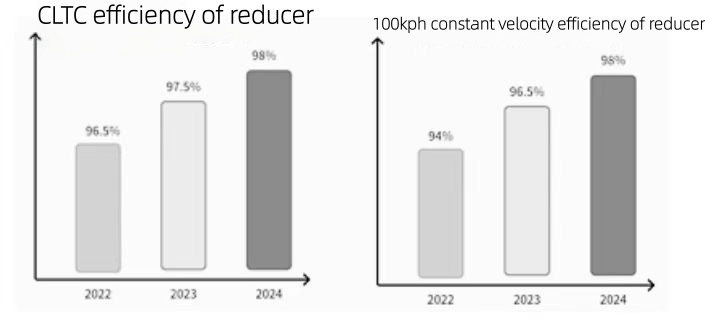
Development Status and Challenges of Transmission Assembly As a power transmission system in electric drive, the reducer can reduce speed and increase torque to meet the normal power demand of users. It mainly includes gear system, bearing, differential, housing and other accessories. The key attributes and performance requirements are space size, weight, efficiency and NVH.   Current electric drive reducers predominantly feature a single-speed, two-stage parallel shaft design, which offers a simple structure and high cost-effectiveness, making it the undisputed mainstream solution. However, as users increasingly demand more space and range in vehicles, the pressure on various subsystems grows significantly. As a critical component, electric drive reducers now face substantial challenges in space, weight, and efficiency. Leading OEMs and international powertrain giants are actively exploring innovative architectures, such as planetary gear arrangements.   Currently, planetary gear mass-production models are predominantly found in mid-to-high-end vehicles from international brands like Audi e-tron, Jaguar Land Rover I-Pace, and Lucid Air. In China, only the Jike brand and select Geely models will adopt this technology starting in 2024. Meanwhile, the passenger car planetary gear supply chain market is almost entirely dominated by global giants such as Schaeffler and ZF. Domestic manufacturers like Xingqu are actively expanding their presence in this field. Moving forward, coaxial planetary gears are expected to gain significant market traction, particularly in mid-to-high-end vehicle segments.   The requirement for high compactness in transmission systems   ▶ present situation   As a key powertrain component, the electric drive greatly affects the vehicle layout. With the increasing demand of the public for the interior space and luggage compartment space, and the platformization of the vehicle and powertrain, the powertrain is required to have a high adaptability to the vehicle layout.   Therefore, the space and regularity of the electric drive are required to be higher. As shown in the figure below, the size of the transmission system directly affects the X direction (longitudinal direction of the vehicle) of the electric drive, and then affects the space in the car or the space in the luggage compartment.   Figure 1 Schematic diagram of transmission system layout Source: Public information   The current transmission system predominantly employs parallel shaft configurations, where the X-axis dimensions are directly influenced by the distance between the input and output shafts. Industry standards for X-axis dimensions are generally as outlined in the table below. Although planetary gearboxes currently hold a small market share, their demand is projected to grow significantly in the future. Schaeffler, a leading advocate of planetary gearboxes, has developed models with X-axis dimensions 30% to 40% smaller than traditional parallel shaft systems. Table 1 X dimensions in the industry torque output <3000Nm 3000-4000Nm 4000-5000Nm X-axis dimension <400mm 400-600mm 460-480mm   ▶ throw down the gauntlet   The current transmission system compresses the space to the extreme. After reducing the center distance, it faces risks of shaft-to-tooth strength and NVH (Noise, Vibration, and Harshness).   The reduced center distance imposes constraints on macroscopic parameters of the gear teeth, including module limitations, root bending risks, and tooth surface contact strength challenges. Furthermore, the heightened torque response and frequent regenerative braking demands in new energy vehicles impose stricter strength requirements on gear teeth and differentials. Optimization is required in material selection, heat treatment processes, and surface strengthening techniques.   The need for lightweight transmission systems   ▶ present situation   For new energy vehicles, particularly pure electric models, range is a key concern for users, while weight significantly impacts driving range. The electric drive accounts for approximately 5% of the total vehicle weight, with the transmission system making up about 50% of the electric drive’s weight. Since the transmission system’s weight directly affects both cost and dimensions, low weight is also a critical requirement for the electric drive.   Currently, parallel shaft reducers dominate the market with over 95% adoption, where weight correlates with output torque as shown in the table below. The Zhi Ji L7/L6 series features magnesium-aluminum alloy housings, achieving 30% lighter weight than conventional aluminum alloy housings. Although planetary gearboxes currently hold a small market share, their demand is projected to grow significantly. As a pioneer in planetary gear reducer technology, Schaeffler’s solutions reduce weight by 30% to 40% compared to traditional parallel shaft reducers. Table 2 Relationship between weight and output torque of single reducer torque output <3000Nm 3000-4000Nm 4000-5000Nm Weight (dry weight) <25kg 25-30kg 30-35kg   ▶ throw down the gauntlet   To meet the demand for lightweight transmission systems, reducers are typically optimized through structural design and material selection. Structural optimization directly reduces material usage, but this approach also introduces risks of strength and reliability, as well as NVH (Noise, Vibration, and Harshness) issues. While magnesium-aluminum alloy housings are cost-effective, they suffer from high-temperature creep and poor stiffness, which further exacerbates NVH risks.   The need for efficient transmission   ▶ present situation   Another critical factor affecting vehicle range is electric drive efficiency. Beyond CLTC (China’s New Energy Vehicle Testing and Certification) standards, high-speed constant-speed efficiency has become a key concern for users. Common high-speed driving conditions like 100 km/h and 120 km/h require high-efficiency high-speed transmission systems with low torque output. Key considerations include transmission architecture, shaft layout, bearing selection, gear precision, housing cavity design, and lubricant choice.   With OEMs adopting assembly applications, refined operational conditions, and advancements in component technologies, the CLTC efficiency of gearboxes has been steadily improving. Before 2020, the CLTC efficiency was generally around 97%, with some manufacturers achieving 97.5%. For instance, XPeng Motors’ G9 (2022 model) demonstrated a measured CLTC efficiency exceeding 97.5%, while the G6 (2023 model) reached 97.6%.   ▶ throw down the gauntlet   At present, the high efficiency reducer is basically through reducing the torque loss and reducing the speed loss.   Reduce torque loss by improving gear meshing precision, reducing tooth surface roughness and slip rate, and using low rolling resistance ball bearings.   Reducing speed loss: The dry oil pan minimizes oil agitation loss, and low-viscosity lubricants are recommended.   The high meshing precision and low tooth surface roughness will put forward higher requirements for the shaft gear machining technology and production rhythm, and also mean higher production cost. The protection ability of the shaft gear bearing will be reduced when low viscosity lubricating oil is selected, which brings higher challenge to the reliability of the shaft gear bearing.   The need for low-noise transmission   ▶ present situation   As consumers increasingly prioritize vehicle quietness, the lack of engine noise masking in electric drive systems makes their noise more noticeable. Moreover, the noise from electric drive gearboxes typically falls within the mid-to-high frequency range that users can easily perceive. With recent advancements in domestic vehicle manufacturing processes and material quality, the overall sound quality of vehicles has significantly improved, which has further accentuated the whistling noise from electric drive systems.   In modern drivetrain systems, NVH issues have expanded beyond shaft-to-tooth squealing. Customers now prioritize ride comfort and acoustic quality, while also noticing clunking noises and jerky transitions during torque shifts. This reflects the growing complexity of NVH challenges in automotive engineering.   In standard transmission systems, the semi-damp chamber typically produces an average noise level of 5 decibels (dB) at 1 meter distance and around 70dB(A) under full torque conditions, with some manufacturers achieving noise levels below 65dB(A).   ▶ throw down the gauntlet   Compared to conventional vehicles, new energy vehicles face greater NVH (Noise, Vibration, and Harshness) development challenges due to the absence of the masking effect from internal combustion engines and users’ growing demand for cabin quietness. The transmission system noise in these vehicles predominantly involves mid-to-high frequency sounds that are particularly sensitive to human ears. With numerous rotating components and significant challenges in mass production and assembly stability, transmission noise has become a major source of customer complaints.   NVH (Noise, Vibration, and Harshness) is a subjective perception closely tied to cost considerations. As user expectations vary across different vehicle segments, establishing NVH development objectives must first align with the vehicle’s positioning and target user demographics. The resolution of NVH issues spans the entire vehicle development lifecycle. Once identified, the process involves testing, analysis, computational simulations, problem categorization, solution formulation, and validation. Beyond a robust development process, hands-on experience plays a pivotal role in addressing these challenges.   To address transmission system squealing, structural excitation is the root cause, while path control is equally critical. NVH improvement strategies targeting both source and path often conflict with lightweighting requirements while driving up costs. Beyond the inherent complexity and evolving demands of NVH challenges, achieving multidimensional balance between NVH mitigation measures, lightweighting, and cost control poses a significant decision-making challenge for OEMs and suppliers at all levels.   The Development Status and Challenge of Gear   1.The high-speed rotation requirement of gears   ▶ present situation   High-speed gears have been widely adopted in new energy vehicles, primarily for their ability to transmit power stably at high speeds. Their application involves multiple aspects including material selection, design, manufacturing, and lubrication. The gear speed in new energy vehicles has evolved from 12,000 rpm to over 20,000 rpm, and is now trending toward 30,000 rpm and beyond.   The development of high-speed gears has raised higher requirements for gear design, material selection, and manufacturing, especially in terms of controlling gear lifespan, lubrication, heat dissipation, and NVH (Noise, Vibration, and Harshness).   ▶ throw down the gauntlet   Reliability: High-speed operation accelerates tooth surface contact fatigue, fretting fatigue, and stress concentration, leading to premature gear failure. Currently, materials such as 20MnCr5 are selected for gears, which offer higher strength, better toughness, and superior heat treatment and processability.   Lubrication & Heat Dissipation: At high rotational speeds, gears experience higher linear velocities, resulting in increased heat generation during meshing and hindering oil film formation, thereby elevating the risk of gear failure. This also poses greater challenges in gear design, requiring stricter specifications for anti-caking properties, slip rates, and linear velocities. A well-designed tooth profile is particularly critical, while the selection of lubricants and proactive lubrication of gears are equally vital.   Dynamic balancing: As the rotational speed increases, the impact of dynamic balancing factors on the NVH of electric drives gradually intensifies, and the dynamic balancing requirements for shaft-to-tooth components become more stringent. Currently, all shaft-to-tooth components now include dynamic balancing inspection requirements.   Gear NVH: The expanded torque, speed, and rotational frequency ranges at high gear speeds significantly increase NVH control complexity. This raises challenges in managing gear excitation and vehicle transmission paths, requiring coordinated design of both electric drive sound packages and vehicle sound packages, along with vibration and noise isolation for structural pathways. At higher speeds, the torque and speed ranges broaden considerably, while the corresponding rotational frequency range nearly doubles, substantially complicating NVH control. As a result, acoustic packages have become a standard feature in electric drive systems.   Gear manufacturing: The precision requirements for gears are becoming increasingly stringent. Currently, the industry is transitioning from the national standard grades 5-6 to grades 5 and above, making the manufacturing process more challenging.   The requirement for high gear ratios   ▶ present situation   With the development of motor performance, the peak speed of motor is gradually increased, the limit of the maximum speed is gradually improved, and the limit of the gear ratio is gradually released.   Considering the vehicle acceleration and electric drive economy, increasing the speed ratio can quickly improve the wheel-end torque of the vehicle, and reduce the volume of the motor to achieve the economic index.   As the peak speed of the motor approaches 20,000+, the gear ratio is also showing a gradual increasing trend. For example, Huichuan has mass production projects with a gear ratio> 12, and Huawei has mass production projects with a gear ratio> 13. Designs with gear ratios above 13 are gradually becoming the norm.   ▶ throw down the gauntlet   The application of high-speed ratio gears has increased the difficulty in both gear performance and manufacturing.   NVH performance: High-speed ratio gears typically generate more noise and vibration, and their design, material selection, and manufacturing pose greater technical challenges.   In terms of reliability, high speed ratio gear needs to bear larger torque and speed, and the linear speed of gear meshing is also larger, which puts forward more strict requirements on the reliability index of bending and contact.   Material: With the increase of the speed and torque, the performance of the gear material is also required to be higher, which needs to consider the strength and wear resistance.   In the manufacturing, the high speed ratio gear is more sensitive to the gear meshing excitation, which makes the gear require higher precision and consistency.   High NVH requirements for gears   ▶ present situation   Unlike internal combustion engines, new energy vehicles are more sensitive to gear NVH performance, requiring higher NVH standards for gear systems, particularly in terms of transmission smoothness and noise reduction.   Gears are a key power source in electric drive systems. Given their lengthy manufacturing processes and high control complexity, NVH (Noise, Vibration, and Harshness) issues in gears pose a significant challenge for the industry. Industry statistics indicate that 70-80% of aftermarket NVH problems stem from bearings and gears, with gear-related issues accounting for 50-60%. Gear NVH is a major contributor to overall vehicle NVH performance. As high-speed and high-ratio gears become increasingly prevalent, addressing NVH challenges in gears has emerged as the industry’s top priority.   ▶ throw down the gauntlet   Gear NVH involves multiple aspects such as gears, electric drive, chassis, and the whole vehicle. It is a systematic control index with a wide range and great difficulty in control. At the beginning of the design, risks should be identified and controlled in advance from the dimensions of gear design & manufacturing and path.   In gear design, NVH of shaft gear involves many fields, such as gear design, machining, assembly, shell support stiffness, bearing stiffness, shaft gear mode, shell mode, electric drive mode, motor mode, transmission path, acoustic radiation, etc. Figure 2: Axis-tooth squeal control points Source: Compiled from public data   In gear manufacturing, precision requirements are escalating. While the industry currently adheres to national standard grades 5-6, rising NVH (Noise, Vibration, and Harshness) demands now require specific gear precision metrics to exceed grade 4, posing significant challenges for both accuracy and consistency assurance. Given the lengthy processing cycle and multiple critical stages, stringent controls are essential across all phases—from material selection and blank production to heat treatment, finishing, and gear grinding. Each process requires precise parameter optimization, further complicating manufacturing. Comprehensive monitoring is imperative for NVH-critical parameters including tooth profile orientation, cumulative runout, surface roughness, Fourier analysis, tooth surface waviness, three-dimensional profile, dynamic balance, and grinding patterns.   The Development Status and Challenges of Bearing   High-speed requirements for bearings   ▶ present situation   In 2024, the industry’s bearing requirements generally specify rotational speeds between 16,000 and 23,000 rpm, with some OEMs developing ultra-high-speed motors during pre-research stages that require 30,000 rpm. From the perspective of bearing usage across OEMs,imported brands dominate high-speed bearing applications, while domestic brands are rapidly catching up in both technological development and installation verification.   ▶ throw down the gauntlet   Ultra-high-speed bearings with low friction and temperature rise, using special heat-treated steel balls or low-cost ceramic balls.   High-speed lightweight cage design to suppress the “umbrella effect” in pocket holes, along with the R&D and design simulation of specialized cage materials.   High-speed bearings require higher internal precision, such as roundness, ripple, roughness, profile, runout, etc.     time line 2015-2017 2018-2019 2020-2024 2025 2030 bearing dmN 800,000 1 million 1.5 million 180,000 2 million Example of bearing rotational speed( unit rpm) 6208→13000 6208→16000 6208→25000 6208→30000 6208→33000 Table 3 Timeline for High-Speed Mass Production of Electrically Driven Bearings (dmN: a rotational speed parameter measured in mm·r/min)   The need for high efficiency in bearings   ▶ present situation   Current electric drive systems predominantly utilize low-friction bearings. For instance, the XPeng XPower 800V electric drive platform employs industry-leading low-friction bearing designs throughout. To balance gearbox design redundancy and cost considerations, most intermediate and output shaft support bearings adopt tapered roller bearing combinations. For optimal operational efficiency, lower-friction deep groove ball bearings (DGBB) paired with cylindrical roller bearings (CRB), or dual-row ball bearings (TBB), would be more suitable.   ▶ throw down the gauntlet   Cone roller bearings deliver lower friction loss through optimized flange convexity design, ultra-precision manufacturing, and nylon cage.   The bearing features miniaturization and custom design, utilizing high-purity steel with specialized heat treatment and coating reinforcement technologies.   Select the optimal bearing efficiency combination based on actual operating conditions, such as DGBB+CRB, TRB, or TBB.   Development demand of insulating bearing   ▶ present situation   With the industry’s widespread adoption of 800V high-voltage platforms for electric drives, power modules in inverters have transitioned from IGBT to SiC, resulting in faster switching speeds. The high dv/dt (voltage-to-current rate) has dramatically increased the risk of electrical corrosion in bearings, demanding enhanced insulation protection. While hybrid ceramic ball bearings currently offer the most ideal insulation, their exorbitant manufacturing costs remain a major industry pain point. Meanwhile, low-cost insulated bushing bearings are being actively developed, with leading manufacturers including SKF, Ensk, Fuji Electric, and Renben.   ▶ throw down the gauntlet   Development of low-cost ceramic ball bearings and localization of ceramic powder supply chain. The insulation bushing bearing is developed with the target insulation impedance of 800Ω@1~5MHz.   time line 2018-2020 2021-2023 2024 2025 and beyond voltage platform 800,000 1 million 1.5 million 180,000 motor bearings ball bearing hybrid ceramic ball bearing The insulation layer has an impedance of 400Ω (1-5MHz). The insulation layer has an impedance of 800Ω (1-5MHz).   Table 4 Voltage Platform and Bearing Selection Trend   Trends and Planning of Transmission System Assembly   The electric drive system is developing towards the multi-objective direction of compact size, low weight, high efficiency and low noise, which provides more space, higher endurance and more comfortable riding environment for the vehicle.   ▶ Development Direction: Coaxial planetary gear technology aligns with the development objectives of electric drive systems and is emerging as the mainstream trend for future electric drive systems, particularly in high-torque electric drive products. To deliver high-performance experiences for users, planetary gears will gradually dominate the market. Both domestic OEMs and Tier1 manufacturers are actively investing in and developing this technology. Core components and processes of planetary gears, such as gear rings, planetary gear mechanisms, planetary carrier stamping, and welding, show significant growth potential.   To meet users’ demands for optimal handling and versatile power output across various scenarios, distributed electric drive systems (including central integrated distributed drive, wheel-side drive, and hub motors) along with multi-speed transmission systems are being deployed in specialized applications, significantly enhancing the user experience across diverse operating conditions and environments. Meanwhile, most small-torque electric drive systems continue to utilize parallel shaft transmission configurations, ensuring optimal cost-performance ratios for end-users.   ▶ Supply Chain and Cooperation Model: With the country’s emphasis on the new energy vehicle industry, compared to the traditional transmission industry, the initial technical threshold and industrialization investment threshold for electric drive systems are both lower, further promoting the continuous development of China’s new energy electric drive system industry. From the initial dominance of the supply chain, it has gradually evolved into a dual-track approach of supply chain plus OEM self-developed and self-manufactured systems. As market competition intensifies and the integration level of electric drive systems continues to improve, the future supply chain will be more closely integrated with OEMs,with clear division of labor, to ensure long-term market stability.   Trends and objectives for high-efficiency transmission systems   With the continuous improvement of efficiency targets, technologies such as ultra-high-precision shaft teeth, low rolling resistance bearings, low oil agitation loss shaft arrangements, active lubricant dry oil pan systems, and ultra-low viscosity lubricants will be progressively adopted. Coupled with the widespread use of coaxial planetary gear reducers, the CLTC efficiency target for transmission systems is expected to exceed 98% by 2024.   Future efficiency gains will transcend isolated upgrades to components or sub-assemblies, focusing instead on system-level optimization and integrated multi-strategy applications. Efficiency metrics will become more granular, with automakers now prioritizing real-world performance metrics like 100km/h and 120km/h steady-state range—beyond the conventional CLTC (China Light-Duty Test Cycle) benchmark—to better align with users’ daily driving needs.       Figure 3 Efficiency levels of electric drive industry reducers in the past three years The trend and objectives of lightweight design   From 2027 to 2030, planetary gear sets are expected to be widely adopted in high-power, high-torque electric drive systems, reducing weight by 30% to 40% compared to current standards. With advancements in new materials (e.g., magnesium-aluminum alloy housings) and manufacturing processes (such as welding differential bolts instead of screws, and stamping die-cast differential housings), the drive system weight is projected to decrease by an additional 5%.     time 2027-2030 torque output <3000Nm 3000-4000Nm 4000-5000Nm Weight (dry weight) <15kg 15-18kg 18-25kg   Table 5 Relationship between Transmission System Weight and Torque Output   Trend and goal of low-noise transmission system   To meet users’ increasingly stringent comfort requirements, the transmission system has progressively enhanced its excitation optimization and path simulation capabilities, with NVH targets varying across different vehicle classes.   Alongside advancements in simulation techniques, NVH research has shifted focus toward user-critical driving conditions. The initial development emphasis has transitioned from 100% torque NVH performance to real-world scenarios like light throttle and steady-state driving.   NVH issues are inherently systemic challenges. As user demands grow, solutions for electric drive NVH problems are evolving from isolated fixes to comprehensive system-level approaches, balancing cost-effectiveness. This includes strategies like noise masking for gear stage background noise, localized acoustic packaging, and frequency-specific optimization of acoustic materials. With continuous advancements in transmission reducer component manufacturing, noise levels in drive systems are progressively decreasing.   The noise standard of the transmission system is 1.5 m average noise, and the target trend prediction is shown in the table below.   Noise of Half-Load Bench at Full Torque Condition time 2024-2027 2027-2030 Low-end model 70dB(A) 68dB(A) Mid-to-high-end car models 65dB(A) 60dB(A) Table 6: Average Noise Trends   Trends and targets of spatial dimensions   In order to meet the demand of larger interior space and platform layout of powertrain, the powertrain is required to be compact and regular in shape, and the transmission is gradually developing from parallel shaft to planetary coaxial arrangement.   The planetary arrangement offers superior spatial dimensions, particularly in the X-axis direction compared to parallel-axis configurations. With equivalent output capacity, the X-axis configuration can reduce the space requirement by approximately 40%.   Axis Gear Trends and Goals   To meet the development of new energy vehicles, the performance requirements for gears are becoming increasingly stringent.   ▶ Lightweighting: With the development of new energy vehicles towards lightweight, gears and transmission systems are also optimized towards smaller volume and lighter mass; structural innovation, small center distance gears and planetary gear reducer configurations have become the industry development trend.   ▶ High-efficiency transmission: To improve the range and overall energy efficiency of new energy vehicles, high-efficiency gears and transmission systems are continuously optimized in terms of conversion efficiency, transmission ratio, and torque density. High-speed and high-ratio gears are becoming the trend.   ▶ High NVH performance requirements: Noise control is critical to the ride comfort of new energy vehicles. High NVH performance gears have become a key control indicator in the development of new energy vehicle gears. The design dimension is controlled in advance, involving multi-dimensional design control such as gear structure, machining, assembly, housing support stiffness, bearing stiffness, shaft-to-tooth modal, housing modal, electric drive modal, motor modal, order avoidance, transmission path, and acoustic radiation.   ▶ Materials and Manufacturing: High-performance materials including high-strength steels, advanced alloys, non-metallics, and composites are being progressively adopted. The precision requirements for gears are increasingly stringent, with national standards mandating Grade 5 or higher precision, and some parameters reaching Grade 4 or higher. A comprehensive control system integrates human, machine, material, method, and environmental factors in gear manufacturing. Strict coordination across all machining processes ensures full sequence precision. The implementation of new technologies such as honing, ultra-finishing grinding, and precision gear manufacturing enhances accuracy while maintaining consistency.   ▶ Because of the tooth tolerance, gear machining error, assembly error, etc., the gear has other order besides the characteristic order, so the control of gear precision is very important.
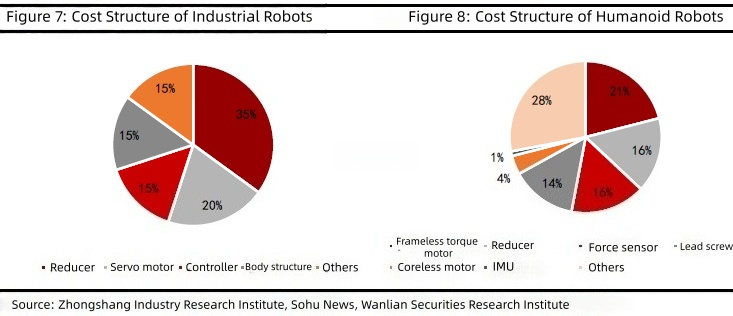
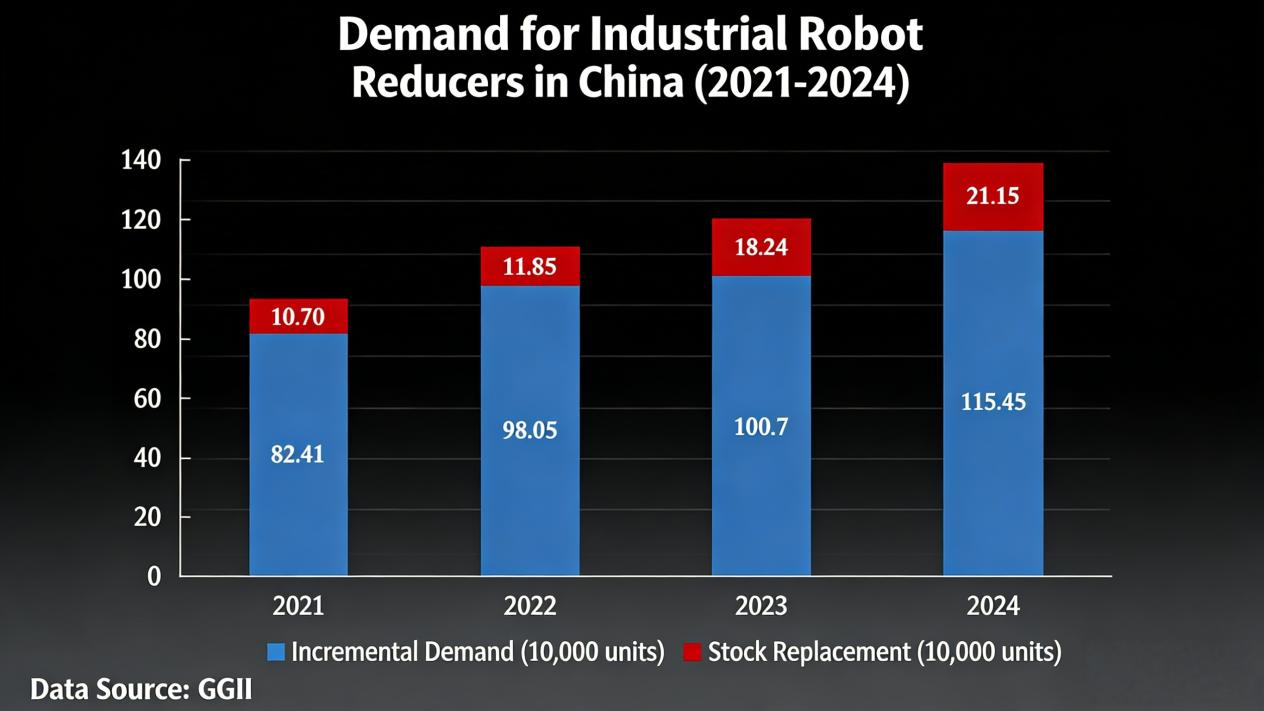
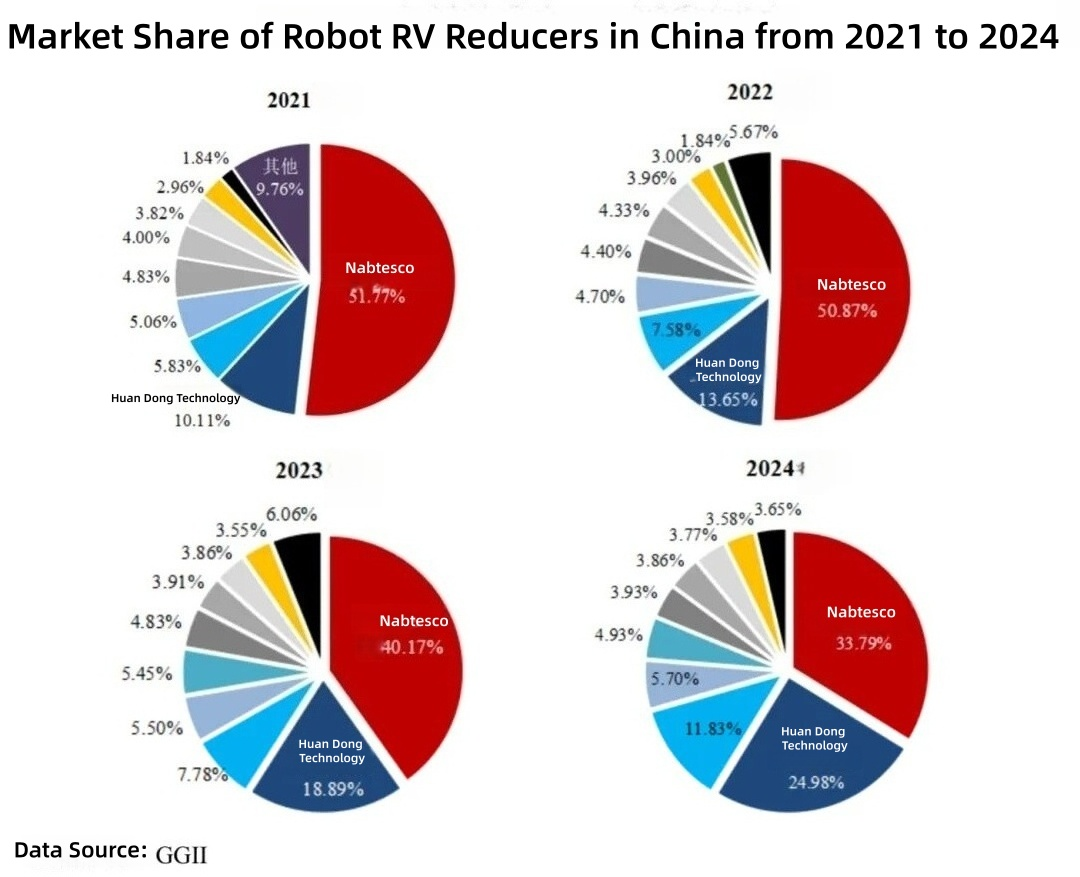
Technical Overview of Reducers 1.1 Working Principle and Main Classification of Reducer In mechanical transmission systems, a reducer functions as a critical intermediate device connecting the power source and actuator. Its core mechanism involves gear reduction and torque amplification through mechanical transmission. Specifically, the reducer employs a gear system where the input shaft (with fewer teeth) meshes with the output shaft’s larger gear, effectively decelerating the high-speed rotational force of the prime mover while increasing the output torque. As a result, reducers are extensively utilized in low-speed, high-torque transmission equipment and are considered a key factor influencing robotic performance. Reducers come in diverse types and models to meet the varying power transmission needs across industries. They can be classified in multiple ways. Based on control precision, reducers are categorized into general-purpose reducers and precision reducers. General-purpose reducers offer lower control precision but suffice for basic power transmission in general machinery. Precision reducers, on the other hand, feature high accuracy, extended service life, minimal backlash, and superior reliability, making them ideal for high-precision control applications in industrial robotics, collaborative robotics, industrial automation, and other advanced manufacturing fields. Precision reducers, primarily RV reducers and harmonic reducers, are core components in high-end equipment manufacturing such as robotics, accounting for approximately 35% of the total cost of an industrial robot. These reducers are widely used in high-precision control applications including industrial robots, collaborative robots, and industrial automation, where they face high technical barriers. Specifically, harmonic reducers are designed for lightweight, low-load applications, while RV reducers are optimized for medium-to-high load scenarios requiring high torque and rigidity. The latter demands more advanced technology, presents greater challenges in production and assembly, and has a lower domestic production rate. Currently, Japan’s Nabtesco maintains a leading position in this global market. Due to their distinct technical characteristics in transmission principles and structural designs, these two systems demonstrate complementary advantages in downstream products and application domains, serving diverse scenarios and end-use industries. A concrete comparison in industrial robotics is as follows: project RV decelerator harmonic reducer Transmission principle and deceleration structure The reducer is composed of the first stage involute planetary transmission and the second stage cycloidal planetary transmission. At least two eccentric shafts are used to connect the second stage reducer. The pinion and cycloidal gear are made of solid castings and steel parts. The system is composed of three core parts: the flexible wheel, the rigid wheel and the wave generator. It is simple and compact, and the material, volume and weight are lower than the RV reducer. performance characteristics Large volume, high load capacity (allowable torque load can reach 28,000 N·m), high stiffness; but at the same time, the product uses relatively complex over-positioning structure, manufacturing process and cost control is more difficult The volume is small and the load is low (the allowable torque load is up to 1,500 N·m), but the key gear is a flexible element, and its performance is gradually reduced under repeated deformation, and the bearing capacity and life of the product are limited. load bearing capacity and life The product can achieve higher product torque and anti-impact ability, torsional overturning stiffness, fatigue strength is greater, precision life is longer, high motion precision. The flexible gear transmission has low fatigue life and weak torsion resistance. synovial joint It is more suitable for large torque and heavy load joints such as robot base, waist and upper arm. It is generally used for light load positions such as forearm, wrist and hand. Actual usage RV reducers are primarily used for loads above 20kg, while RV harmonic reducers are recommended for loads between 6kg and 20kg. For loads under 6kg, harmonic reducers are typically used. Main terminal application areas The field of medium and heavy-duty robots, represented by industries such as automotive, photovoltaic, welding, bending, spraying, palletizing, metal processing, transportation, and port terminals. The 3C electronics, semiconductor, food, injection molding, mold, and medical industries are in high demand for light-duty robots.   1.2 Working Principle and Characteristics of RV Reducer As defined in GB/T 34897-2017 “Precision Bearings for RV Reducers in Rolling Bearing Industrial Robots”, an RV reducer is a transmission mechanism comprising a planetary gear reducer as the front stage and a cycloidal pinwheel reducer as the rear stage. It features a high transmission ratio and self-locking capability under specific conditions.   The RV reducer, developed from traditional pin-torsion planetary transmission, features a dual-stage reduction system comprising a planetary gear reducer as the front stage and a cycloidal pinwheel reducer as the rear stage, with at least two eccentric shafts connecting the two stages. Its housing and cycloidal pinwheel are solidly coupled through castings and steel components, forming a closed differential gear train. This innovation not only overcomes the limitations of conventional cycloidal pinwheel transmissions but also delivers a range of advantages including high precision (with tooth clearance below 1 arc minute), exceptional rigidity, superior durability, high output density (compact yet powerful), a broad speed reduction ratio, and minimal vibration. The motion transmission process of the RV reducer operates as follows: The servo motor’s rotation is transmitted to the planetary gears through the input gear. Based on the gear ratio between the input gear and the planetary gears, the speed is correspondingly reduced (first-stage reduction). The crankshaft is directly connected to the planetary gears, maintaining the same rotational speed. Two cycloidal gears are installed between the eccentric section of the crankshaft and the needle roller bearings. When the crankshaft rotates, the cycloidal gears mounted on the eccentric section also perform eccentric motion around the input shaft. On the other hand, the needle roller housing contains needle rollers evenly spaced at intervals, with one additional roller per cycloidal gear. As the crankshaft completes one full rotation, the cycloidal gears engage with the needle rollers while undergoing eccentric motion. During this process, the output planetary carrier rotates one tooth’s distance in the opposite direction to the crankshaft’s rotation. This rotation is then transmitted to the shaft of the second-stage reduction unit (second-stage reduction). The total reduction ratio is the product of the reduction ratios from both first and second stages. The situation of precision reducer industry in China 2.1 The successive introduction of national strategies and industrial policies has driven the rapid development of domestic precision reducers. In recent years, industrial policies have provided strong support for technological breakthroughs and accelerated development in industrial robots and precision reducers. The government has designated robotics and high-end CNC machine tools as one of the ten key priority areas requiring vigorous promotion, with specific requirements to achieve engineering breakthroughs and industrialization of intelligent core components like reducers. The 14th Five-Year Plan and its supporting plans outline strategies to deepen the manufacturing power strategy, optimize and upgrade the manufacturing sector, cultivate advanced manufacturing clusters, and drive innovation in industries such as robotics. The plan emphasizes the development of intelligent manufacturing equipment, addressing weaknesses in perception, control, decision-making, and execution through industry-academia-research collaboration. Key objectives include overcoming critical bottlenecks in foundational components and devices, as well as developing advanced controllers, high-precision servo drive systems, and high-performance, high-reliability reducers.   For instance, the “14th Five-Year Plan for Robot Industry Development” outlines that in the face of new circumstances and requirements, the next five years and beyond will be a strategic opportunity period for China’s robotics industry to achieve self-reliance, innovation, and leapfrog development. It emphasizes seizing opportunities, confronting challenges, and accelerating solutions to issues such as insufficient technological accumulation, weak industrial foundations, and lack of high-end supply, thereby propelling the robotics industry toward mid-to-high-end development. The plan advocates for high-end and intelligent development, targeting industrial transformation and consumption upgrades. Key priorities include breaking through core technologies, consolidating industrial foundations, enhancing effective supply, expanding market applications, improving supply chain stability and competitiveness, continuously refining the industrial ecosystem, and driving high-quality growth in the robotics sector. The development goals set forth in the plan are: By 2025, China aims to become a global hub for robotics innovation, a cluster for high-end manufacturing, and a new frontier for integrated applications. Breakthroughs will be achieved in core robotics technologies and premium products, with overall performance metrics reaching international advanced levels and key components matching the reliability of global counterparts. The robotics industry’s annual revenue growth rate will exceed 20%, fostering a group of internationally competitive leading enterprises and numerous innovative, high-growth specialized “little giant” enterprises. Three to five globally influential industrial clusters will be established. Manufacturing robot density will double. By 2035, China’s robotics industry will achieve world-leading comprehensive strength, with robots becoming integral components of economic development, people’s livelihoods, and social governance. The plan outlines key objectives: strengthening industrial foundations, enhancing the functionality, performance, and reliability of critical robot components, and developing advanced manufacturing technologies for high-performance reducers, including RV reducers and harmonic reducers. These efforts will improve precision retention (longer lifespan), reliability, and noise reduction, paving the way for mass production.   The successive rollout of national and industrial policies has provided strong support for the rapid development of domestic precision reducers.   2.2 Benefiting from the growing demand for industrial robots, the market for industrial robot reducers, including RV reducers, is expanding rapidly. According to GGII data, China’s total demand for industrial robot reducers increased from 931,100 units to 1,366,000 units between 2021 and 2024, with a compound annual growth rate (CAGR) of 13.63%. The incremental demand rose from 824,100 units to 1,154,500 units, achieving a CAGR of 11.89%. As digitalization accelerates, the automation of human labor will gain significant benefits. As a core component driving industrial automation, supporting industrial upgrading and smart manufacturing, reducers are poised for long-term growth. 图片4   2.3 The Rise of Domestic Brands in Industrial Robots and RV Reducers In recent years, driven by surging downstream demand, expanding application fields, and bolstered by industrial policies and collaborative efforts among government, industry, academia, research institutions, and end-users, China’s industrial robotics sector has prioritized breakthroughs in core technologies. Domestic manufacturers have consistently overcome technical hurdles in critical components like gearboxes, steadily enhancing their technological prowess and competitive edge. The performance gap between Chinese products and global leaders continues to narrow. In China’s industrial robot market, domestic brands are rapidly rising, and the import substitution process is accelerating. With breakthroughs in key technologies, improvements in the performance of domestic robots, and the optimization of the supply chain system, domestic industrial robot manufacturers have seized market opportunities to achieve rapid growth in recent years. Meanwhile, China’s industrial robot reducer industry, including RV reducers, has entered a phase of rapid growth. With domestic RV reducer manufacturers enhancing their technical capabilities and product performance, gradually expanding production capacity, and gaining increasingly prominent pricing and cost-performance advantages, leading domestic industrial robot manufacturers are rapidly increasing the localization rate of RV reducers in procurement. This trend is driven by considerations such as supply chain security and stability, procurement costs, and procurement cycles. The domestic industrial robot reducer market demonstrates significant growth potential and vast market space.   Industry technical level and characteristics The RV reducer industry is characterized by high technical difficulty, high investment threshold, and high industry barriers. It requires substantial capital and talent investment in R&D design, quality control, product testing, assembly, and trial verification. The manufacturing process imposes strict requirements on materials, production equipment, and process precision. This industry is a technology-intensive, capital-intensive, and talent-intensive sector. The key technical parameters of industrial robot RV reducers include torsional stiffness, starting torque, transmission accuracy, backlash, clearance, transmission error, transmission efficiency, and noise. The design, development, and manufacturing of RV reducers require repeated testing and adjustments of related materials, component structures, and gear profiles, a process demanding 5-6 years of technical expertise and experience. The precision requirements of RV reducers determine their high technical content in production. Major technical challenges include their two-stage reduction design, where even minor errors at the front end are amplified during output, affecting product accuracy. Additionally, to ensure transmission of high torque, withstand significant overload impacts, and maintain expected service life, RV reducers employ over-positioning structures in their design. This necessitates high-precision machining and presents substantial processing difficulties. Particularly during mass production, achieving stability, reliability, and consistency in product performance and quality becomes even more challenging. In recent years, supported by industrial policies and collaborative efforts among government, industry, academia, research institutions, and users, China’s robotics R&D has prioritized breakthroughs in core technologies. Through years of independent innovation and technology absorption, some domestic enterprises have successfully overcome technical challenges in key components like reducers, steadily enhancing their technological capabilities and core competitiveness. Their products now meet internationally advanced standards in technical specifications and performance. Particularly in industrial robotics, manufacturers like Huan Dong Technology, a leading RV reducer producer, have filled the supply-demand gap for core components in China’s industrial robotics sector through sustained independent R&D and investment.   The main barriers to entering the industry 4.1 Barriers to Advanced Manufacturing Technologies The RV reducer industry is a technology-intensive, R&D-driven sector where product development and innovation demand robust technical capabilities and dedicated R&D resources. The entire lifecycle of an RV reducer—from design and development to mass production—requires years of iterative testing, refinement, and the accumulation of technical expertise. Given the industry’s broad application scope, leading players have developed advanced R&D and process design capabilities, along with extensive technical knowledge and experience. They can precisely identify industry trends, stay ahead of technological advancements, and effectively address product iteration needs. New entrants, however, often struggle to meet market demands in areas like technical expertise and talent development, making it difficult for them to achieve significant breakthroughs quickly and putting them at a competitive disadvantage.   4.2 Customer Access Barriers For downstream industry clients, the performance and quality of RV reducers directly impact the quality and other characteristics of host products. When selecting RV reducer manufacturers, downstream clients maintain a rigorous supplier qualification system. Industry manufacturers must not only pass internationally recognized quality system certifications but also meet the evaluation criteria established by individual clients. The supplier selection process typically involves extended periods of stringent audits and product performance assessments. Clients generally test suppliers’ products on multiple performance metrics including precision, reduction ratios, load capacity, transmission efficiency, service life, and stability, with some clients conducting tests lasting tens of thousands of hours. For these clients, once a supplier enters their network, stable partnerships are typically established. Consequently, the RV reducer industry maintains certain customer entry barriers.   4.3 Barriers to Capital Investment and Large-Scale Production RV reducers demand high performance standards and advanced manufacturing processes, involving multiple production stages, diverse raw material requirements, and a significant need for high-performance materials. They also require comprehensive accessory kits. Meanwhile, customers increasingly demand extended delivery cycles and expanded product ranges to meet their varied application scenarios. To address these needs, RV reducer manufacturers must develop multi-variety, large-scale production capabilities. This requires substantial capital investment, technical expertise, and operational experience in equipment procurement, production scaling, and process control to establish competitive advantages. On one hand, companies must invest heavily in precision machining and testing equipment, which demands high-end machinery often imported or custom-made. These systems face prolonged delivery and installation periods with costly maintenance. On the other hand, ensuring product reliability and stability necessitates standardized production protocols, real-time monitoring, and multi-stage quality checks. Consequently, new entrants to the industry struggle to achieve mass production capabilities within short timeframes.   Trends in the industry 5.1 Import substitution accelerates, domestic manufacturers welcome rapid development opportunities Currently, mainstream international brands still dominate the global RV reducer market, with high sales prices and expensive after-sales maintenance costs. This situation has somewhat hindered the development of domestic robot manufacturers. With the implementation of industrial incentive policies such as the “14th Five-Year Plan for Intelligent Manufacturing Development” and the “14th Five-Year Plan for Robot Industry Development,” the manufacturing of intelligent key basic components has become a crucial industry for national technological breakthroughs. Meanwhile, through technological breakthroughs and process improvements, some domestic enterprises have achieved world-leading standards in performance and stability. With superior cost-effectiveness and localized service advantages, domestic brands continue to expand their market share while accelerating import substitution. Looking ahead, as China advances in theoretical research, manufacturing, and testing equipment development, and gains technical expertise in materials, precision machining of key components, and complete assembly processes, domestic brands will increasingly earn recognition from downstream clients.   5.2 The pace of industry standard development has accelerated, with significant improvements in product technology levels. Industry standards serve as regulatory frameworks that standardize practices, drive innovation, and guide sector development. By continuously refining standardization processes and accelerating the development of updated specifications, these standards enhance operational efficiency within the industry. The reducer market features diverse specifications, yet current industry standards exhibit delayed updates and incomplete coverage. Particularly for high-end precision RV reducers, existing standards remain out of sync with global benchmarks, hindering the industry’s rapid evolution. As intelligent transformation accelerates, the development of industry standards will increasingly align with technological advancements, product innovations, and manufacturing processes. Moving forward, industry standards will adopt a holistic approach covering the entire reducer supply chain. This comprehensive strategy will guide RV reducer manufacturers toward achieving higher and more consistent technical standards, ultimately improving mechanical precision, service life, operational stability, and reliability in the RV reducer sector.   5.3 Downstream applications are extensive, with long-term positive industry trends RV reducers demonstrate extensive downstream applications, with industrial automation being a key sector alongside robotics. As technological advancements and industrial automation levels continue to rise, these reducers are poised to expand their applications across more fields, driving diversified downstream demand. Furthermore, fueled by sustained national economic growth and supportive industrial policies, China’s fixed asset investment has shown consistent annual increases. Multiple downstream sectors are witnessing promising development prospects propelled by economic expansion and industrial investments. The market demand and industry scale for RV reducers are projected to maintain a positive long-term growth trajectory.   Opportunities and Risks for Industry Development 6.1 Opportunities Facing the Industry 6.1.1 Strong support and guidance from industrial policies The RV reducer industry is a key sector in China’s advanced manufacturing sector, supported by national industrial policies. Relevant authorities have rolled out a series of development plans, including the “Implementation Opinions on Enhancing Manufacturing Reliability,”  “14th Five-Year Plan for the General Machinery Components Industry,”  “14th Five-Year Plan for Intelligent Manufacturing,”  “14th Five-Year Plan for Robot Industry Development,”  “National Intelligent Manufacturing Standards System Construction Guide (2021 Edition),” and “Guiding Opinions on Promoting Robot Industry Development.” These initiatives have created a favorable environment for the industry’s growth. As a core component of high-precision reducers and industrial robots, RV reducers continue to receive sustained policy support. For instance, the “14th Five-Year Plan for Robot Industry Development” jointly issued by the Ministry of Industry and Information Technology (MIIT) and 15 other departments proposes to “develop advanced manufacturing technologies and processes for RV reducers and harmonic reducers, enhancing their precision retention (service life), reliability, and noise reduction for mass production.” Similarly, the “14th Five-Year Plan for Intelligent Manufacturing Development” released by MIIT and seven other departments lists “high-performance, high-reliability reducers” as a critical category requiring breakthroughs in bottleneck foundational components and devices. In 2023, the National Development and Reform Commission (NDRC) published the “Industrial Structure Adjustment Guidance Catalog (2024 Edition),” which included “high-precision industrial robot reducers” and “robot-specific high-precision reducers” in its encouraged category. The introduction of a series of encouraging and supporting policies by the state has laid a good policy foundation for the development of this industry, and provided a broad industrial policy space and opportunities for the sustained and rapid development of the industry.   6.1.2 The downstream industry continues to develop RV reducers are extensively utilized in high-precision control applications such as robotics and industrial automation. China has emerged as the world’s largest market for industrial robots, accounting for approximately 50% of global demand, which has become a powerful growth engine for the industry. The government will continue to drive intelligent manufacturing transformation, deepen the integration of industrialization and informatization, and enhance industrial automation capabilities to accelerate the development of industrial robots, particularly in three core components: reducers, controllers, and servo systems. Meanwhile, the expanding application sectors and market growth will further expand the RV reducer industry’s market potential. The medium-to-long-term outlook for this sector remains positive, presenting significant development opportunities.   6.1.3 Domestication Requirements for Key Components As critical components in high-end equipment such as robots and CNC machine tools, RV reducers are indispensable in industrial automation and intelligentization, playing a vital role in manufacturing transformation and upgrading. With growing demand for RV reducers in industrial robots, China has faced persistent shortages of core components. The industry once heavily relied on imported international brands for RV reducer production, severely constraining capacity expansion for domestic downstream manufacturers. To accelerate downstream industry development, it is imperative to advance RV reducer technology, alleviating production constraints on robot manufacturers and laying the foundation for smart manufacturing to drive economic growth and industrial transformation. Currently, some domestic RV reducer enterprises have overcome technical bottlenecks and achieved breakthroughs. For domestic downstream manufacturers, the maturation of these key components not only reduces production costs but also unlocks new production capacity.   6.2 Risks Faced by the Industry 6.2.1 The technical and technological capabilities of domestic enterprises are still insufficient. International manufacturers have maintained a clear first-mover advantage. For decades, China’s RV reducer technology lagged behind developed nations, with global market dominance held by foreign brands. Japan’s Nabtesco remains the top domestic producer, while China still heavily relies on imported key components for industrial robots. In recent years, domestic manufacturers like the company have achieved breakthroughs through continuous R&D efforts. Their products are now gaining recognition from downstream industries, breaking the technological monopoly of foreign brands. However, domestic RV reducers still fall short of imported counterparts in precision, durability, stability, and consistency. Common issues include limited product variety and insufficient size options. To compete, domestic manufacturers must increase investment to develop upgraded models for diverse applications. The industry’s growth requires Chinese brands to enhance R&D capabilities, refine manufacturing processes, and expand product portfolios. By building trust through reliable performance, competitive pricing, and localized services, domestic RV reducers can secure a stronger market position.   6.2.2 Limited capacity for large-scale production Compared to international RV reducer giants, domestic manufacturers generally operate on a smaller scale with weaker financial strength, which hinders long-term development. Although policy support has led to the emergence of domestic enterprises with mass production capabilities in recent years, the gap with global industry leaders remains substantial. Most domestic RV reducer manufacturers still face constraints from limited production capacity. While the growing market demand from downstream industries provides an objective foundation for rapid expansion, it also imposes higher requirements on production scale and financial strength. Domestic manufacturers are now facing unprecedented challenges in scaling up production capabilities.   Cyclical, regional or seasonal characteristics of the industry The RV reducer industry shows no distinct cyclical or seasonal patterns, primarily driven by macroeconomic policies and downstream market demand. Domestic players are predominantly based in East and North China, serving clients across these regions, while international competitors are mainly concentrated in Japan.   The position and role of the industry in the industrial chain The RV reducer industry occupies the midstream of the industrial chain. Its upstream consists of suppliers of raw materials and production equipment, including bearings, blanks, steel, cutting tools, and measuring instruments. The downstream primarily applies to high-end manufacturing sectors such as robotics and industrial automation. The upstream industry’s production capacity, delivery quality, and technological standards directly influence the quality and scale of raw material supply for the RV reducer sector. Meanwhile, as RV reducer manufacturers enhance product quality and production processes, their rigorous selection, evaluation, and material verification of upstream suppliers also drive and foster technological advancements among these suppliers. The downstream sector, a high-end manufacturing field prioritized by national industrial policies for intelligent and automated development, has witnessed significant demand growth in recent years. As a core component of downstream products like industrial robots, the RV reducer’s performance, precision, and quality stability critically influence the functionality of downstream host products, making it a pivotal contributor to the advancement of downstream industries.   The relevance between the industry and its upstream and downstream sectors 9.1 Relevance to the upstream industry The primary raw materials for RV reducers include externally sourced components such as bearings, blanks, steel, and cutting tools. The upstream supply chains for bearings, blanks, and steel are predominantly sourced from the steel industry, where market supply remains abundant and competition is intense. Both product quality and supply conditions meet industry demands. In recent years, steel prices have remained relatively stable due to supply-side reforms and overcapacity reduction efforts in the steel sector. However, fluctuations in steel prices—driven by factors like international commodity market trends—may affect the raw material costs and profit margins of reducer products. From a long-term perspective, China’s ample steel supply is unlikely to adversely impact the RV reducer industry.   9.2 Relevance to Downstream Industries As an indispensable component in high-precision equipment, RV reducers are extensively utilized in advanced manufacturing sectors like robotics and industrial automation. Their product quality, reliability, and service life directly determine the performance of host systems, while the industry’s scale and development trends are driven by downstream market demands. In recent years, with the introduction of supportive policies such as the “14th Five-Year Plan for the General Machinery Parts Industry” and the “14th Five-Year Plan for Robot Industry Development,” high-end equipment manufacturing—represented by industrial robots and high-end CNC machine tools—has become a key focus for national development to achieve breakthroughs. Meanwhile, the accelerated industrial restructuring and upgrading have spurred continuous advancements in industrial automation and intelligentization. Benefiting from downstream industry momentum, the RV reducer sector is poised to enter a new phase of rapid growth.   Industry competition landscape In the context of Industry 4.0, developed countries represented by Japan have prioritized advancing the robotics industry. They have achieved complete self-sufficiency in core components like RV reducers and secured significant market share through technological leadership. The RV reducer industry is characterized by high technical complexity, substantial investment thresholds, and stringent industry barriers. It requires substantial capital and talent investment in R&D design, quality control, and product testing. Manufacturing processes demand strict requirements for materials, production equipment, and process precision, making large-scale production challenging. Globally, few manufacturers can reliably supply mass-produced RV reducers with reliable performance. Leveraging their long history, strong capital base, and extensive technical expertise, Japanese companies dominate the global industrial robot reducer market. Notable representatives include Nabtesco, which has established a prominent position through cutting-edge R&D capabilities, large-scale production capacity, consistent product quality, and long-standing collaborations with international industry leaders like FANUC and KUKA. Due to the late start of China’s RV reducer industry, the overall technical level of enterprises in the industry still lags behind that of internationally leading companies. In the domestic RV reducer market, as domestic manufacturers continuously overcome technical challenges, their technical capabilities and competitiveness have steadily improved, narrowing the gap between product performance and the leading levels abroad. According to the “China Robot Industry Development Report (2022)” by the China Electronics Society, the core competitiveness of key components in China’s industrial robots continues to rise. Taking reducers as an example, a group of outstanding enterprises such as Lüde Harmonic (mainly focusing on harmonic reducers) and Huandong Technology (mainly focusing on RV reducers) have become pioneers in leading the development of the domestic reducer market, thanks to their sustained R&D investment, high precision manufacturing capabilities, strict quality control, and continuously improving product systems.   Major companies in the industry Globally, Nabtesco is the market leader in the RV reducer industry. In China’s RV reducer market, besides Nabtesco, Huandong Technology has gained a leading position with a market share approaching 20%, while other companies are relatively smaller. The basic situation is as follows: corporate name Headquarters location Key business operations and market position Nabtesco Japan As the creator of RV reducers and a leading enterprise in the field of motion control, it is the world’s largest manufacturer of robotic RV reducers. According to GGII statistics, its market share in China’s robotic RV reducers was 50.87%,40.17%, and 33.79% in 2022,2023, and 2024 respectively. Circulation Technology China The main product, RV reducer, has basically covered leading domestic robot customers, with strong production and processing capabilities, enjoying high brand awareness in the industry. It has become a professional manufacturer of RV reducers for industrial robots with leading domestic production and sales volume. According to GGII statistics, its market share in China’s robot RV reducer market was 13.65%,18.89%, and 24.98% in 2022,2023, and 2024 respectively. Source: publicly available data, GGII   In recent years, Shuanghuan Technology has achieved rapid market expansion and established dominance in China’s robotics sector through its RV reducers. In 2020, Nabtesco dominated the domestic RV reducer market with 54.80% share, while Sumitomo Heavy Industries held 6.60% and Shuanghuan Technology only 5.25%. From 2021 to 2024, Shuanghuan Technology’s market share rose steadily to 10.11%,13.65%,18.89%, and 24.98%, consistently ranking second only to Nabtesco. During the same period, Nabtesco’s market share declined to 51.77%,50.87%,40.17%, and 33.79%, while Sumitomo Heavy Industries saw its share drop to 5.06%,4.70%,3.91%, and 3.58%. This sustained decline in international competitors’ market share highlights Shuanghuan Technology’s role as a leading domestic alternative to Nabtesco’s products. By progressively replacing imported Nabtesco components, Shuanghuan Technology has solidified its position as the industry leader in China’s robotics RV reducer market. 图片5 [Disclaimer]This excerpt is from Shuanghuan Technology’s prospectus. All rights reserved by the original author. For knowledge sharing and communication purposes only, not for commercial use. We maintain neutrality regarding all viewpoints expressed herein. Should you find any discrepancies between the cited sources and facts, or if there are copyright-related issues, please notify us for prompt revision or removal.  
As a core component in transmission systems, reducers play a pivotal role in reducing rotational speed and increasing torque. Their technical performance directly determines the operational accuracy and stability of downstream equipment. In the humanoid robotics sector, precision reducers are among the key components, accounting for approximately 16% of the cost structure. The transmission accuracy and reliability of these reducers directly impact the flexibility of humanoid robot movements and their adaptability to various scenarios. Market demand analysis indicates accelerated global industrialization of humanoid robots, with a projected 10-billion-yuan incremental market by 2030. As domestic policies increasingly support the robotics industry, the imminent mass production of humanoid robots is creating a window of explosive growth for precision reducers. From a technical perspective, the precision reducer market has long been dominated by foreign enterprises: Harmonic reducers are led by Harmonic Drive with a global market share exceeding 80%; in the RV reducer sector, Japan’s Nabtesco holds over 40% of the market share in China; the precision planetary reducer market is also primarily dominated by Japanese and German manufacturers. This landscape not only highlights the urgency of domestic substitution but also sets a benchmark for domestic manufacturers to achieve technological breakthroughs. From the perspective of domestic substitution, domestic manufacturers have achieved key breakthroughs in technology and market by 2025: the domestic harmonic reducer market size reached 2.49 billion yuan in 2023, with a compound annual growth rate (CAGR) of 16.54% from 2019 to 2023; the RV reducer market size in China is expected to reach 6 billion yuan by 2025, with domestic manufacturers such as Huan Dong Technology continuously approaching international advanced levels in technical capabilities; the global market size of precision planetary reducers grew from 929 million yuan to 1.376 billion yuan from 2020 to 2024, with a CAGR of 10.32%. Domestic high-end products have reached international advanced levels in key indicators such as transmission accuracy, efficiency, and noise, achieving import substitution in some fields, and the localization rate is gradually increasing. At this pivotal juncture for the industry, the growing demand for humanoid robots and breakthroughs in domestic reducer technology have created a synergistic effect, propelling the domestic substitution process into a critical phase of implementation and harvest. Against this backdrop, this report provides an in-depth analysis of the growth drivers, technological pathways, and domestic substitution progress in the reducer sector, offering essential insights for industrial research and investment decisions.   Reducer: Core Components in Transmission Field, Market Size Steadily Growing 1.1 The reducer serves dual functions of speed reduction and torque enhancement, with extensive downstream applications. As the pivotal component connecting power sources to actuating mechanisms, gear reducers function through multi-stage gear meshing to reduce input speed while amplifying output torque, making them indispensable in mechanical transmission systems. Given that most industrial machinery operates under high-load, low-speed conditions where direct prime mover drive is impractical, gear reducers are essential for achieving speed-torque matching. Through precision gear ratio design, they proportionally decrease input speed while proportionally increasing output torque, ensuring optimal alignment between power parameters and load requirements. As the core element of modern mechanical transmission, the performance of gear reducers directly determines the transmission efficiency, operational accuracy, and equipment reliability of power systems. This makes them irreplaceable in critical applications such as automated equipment, construction machinery, and transportation systems. The market size of China’s reducer industry is showing a steady upward trend, with a long-term growth rate maintained at around 5%. According to data from Rui Guan Consulting, the market size of China’s reducer industry reached 144.7 billion yuan in 2024, and the growth rate has remained within the 5% range in recent years. Influenced by the reduction in domestic labor force and the deepening of population aging, manufacturing enterprises are accelerating the transition to automated production to reduce labor costs and improve production efficiency, which directly drives the demand growth for core components of industrial automation such as reducers. Meanwhile, domestic reducer manufacturers are continuously enhancing the market competitiveness of domestically produced reducers by introducing, digesting, absorbing, and innovating advanced foreign technologies, promoting the process of product localization and substitution, and gradually reducing dependence on foreign technologies. The downstream applications of reducers cover numerous industries and play a crucial role. With their excellent load-bearing capacity, reliability, durability, and precise control over speed and torque, reducers are key to enhancing the efficiency of entire production systems across various industries. Their downstream applications primarily include lifting and transportation, cement and building materials, robotics, heavy mining, metallurgy, and power generation, among other sectors of the national economy and defense industry. Among these, lifting and transportation, cement and building materials, and robotics are the most core application fields for reducers. With China’s sustained economic growth and the deepening of industrial automation, the gross domestic product and fixed asset investment have been rising year by year. As a key basic component of industrial equipment, the market demand for reducers has also been steadily increasing. 1.2 Reducers can be classified into three categories: general-purpose, special-purpose, and precision. Reducers are categorized into three main types: general-purpose reducers, specialized reducers, and precision reducers. Generally speaking, general-purpose reducers are widely applicable, specialized reducers are custom-designed for specific needs, while precision reducers focus on delivering high-precision motion control and positioning capabilities. General-purpose reducers are standard transmission devices primarily designed for medium and small-scale applications. Widely used in industrial gearboxes, conveyor systems, and related sectors, they offer limited control precision, meeting only the basic power transmission needs of most machinery. Leading manufacturers include SEW, Siemens, Guomao Co., Ltd., Ningbo Dongli, Jiangsu Tailong, and Zhongda Lide. Specialized reducers: Customized speed reduction devices developed according to specific industrial needs, typically in large or extra-large specifications, can be optimized for specific application scenarios or industry requirements to meet higher performance standards and special functional needs, such as wind power generation gearboxes, metallurgical gearboxes, etc. Representative companies include China High-Speed Transmission, Hangchi Forward, Weili Transmission, Zhongchi, Jinlei Co., Ltd., etc. Precision reducers, featuring low backlash, high accuracy, long service life, and exceptional reliability, are the preferred choice for precision-critical applications such as robotics and high-end machine tools. Leading manufacturers include HAMERNAK, Nabtesco, Lüde Harmonic, and Zhongda Lide. graph 4 Figure 4: Reducers are classified into general-purpose, specialized, and precision types. level characteristic on behalf of company general reducer Primarily designed for small and medium-sized applications, these modular and serialized units are widely applicable across various industries. SEW, Siemens, Guomao Co., Ltd., Ningbo Dongli, Jiangsu Tailong, Zhongda Lide, and others special reducer Specifications are primarily large and extra-large, mostly non-standard and industry-specific products. China reports on high-speed transmission, Hangchi Forward, Weili Transmission, Heavy Teeth, Jinlei Shares precision speed reduction device With low return clearance, high precision, long service life, and reliable stability, it is widely used in high-end fields such as robotics and CNC machine tools. Hamernak, Nabotsk, Green Harmonics, Zhongda Lide, etc. Source: Guomao Co., Ltd. prospectus, Wanlian Securities Research Institute Depending on their structure and transmission methods, precision reducers can be classified into harmonic reducers, RV reducers, and precision planetary reducers. ① Harmonic reducer: Composed of a wave generator, flexible gear, and rigid gear. With advantages such as compact size, lightweight design, high transmission accuracy, smooth operation, and large transmission ratio, it is particularly suitable for industrial robots and humanoid robots in industries like 3C, semiconductors, and medical devices. It is mainly used in components like robotic arms, wrists, and hands. However, its drawbacks include low torque transmission, inefficient power transfer, and limited service life. ② RV Reducer: This two-stage mechanism combines involute planetary gear transmission with cycloidal pinion planetary transmission. Featuring high transmission efficiency, smooth operation, strong load-bearing capacity, excellent rigidity, and superior overload impact resistance, it is widely used in heavy-load components of industrial robots such as bases, arms, and shoulders. However, its drawbacks include complex structure, high manufacturing difficulty, and elevated costs. ③ Precision planetary gear reducer: compact in size, composed of planetary gears, sun gear and internal gear ring, with compact structure, high torque, high efficiency of single-stage transmission, light weight, long life and maintenance-free, etc. It is mostly used in the body rotation joints of robots with low precision requirements. Its limitation is the small range of single-stage transmission ratio.   Figure 5: Comparison of Three Precision Reducers reducer category design feature merit shortcoming application area diagrammatic sketch harmonic reducer The main components are the wave generator, flexible cabin and rigid cabin. When the reducer operates, the wave generator undergoes controllable deformation, and the power is transmitted through the meshing of the flexible and rigid cabins. High transmission accuracy, small weight and volume, smooth operation, large transmission ratio The torque transfer is relatively small, the transmission efficiency is low, and the service life is limited Joints in robots with lighter loads, such as the forearm, wrist, and hand, are used in fields like aerospace, precision machining equipment, and medical devices. RV decelerator It mainly includes two kinds of transmission devices, which are involute planetary gear transmission and cycloidal pinwheel planetary transmission. The transmission precision is high, the transmission efficiency is high, the transmission stability is high, the bearing capacity is strong, the rigidity and overload impact performance is good. Complex structure, difficult to manufacture, high cost, and limited service life The robot has heavy bases, large joints such as the arm and shoulder precision planetary reducer The compact design mainly includes planetary gears, sun gears, and internal gear rings. Precision planetary reducers typically have a single-stage reduction ratio of 10 or less, with the number of reduction stages generally not exceeding three. Single-stage transmission with 97% efficiency, lightweight design, and a service life of up to 20,000 hours—maintenance-free. The single-stage transmission has a narrow range of transmission ratios. Precision transmission systems for mobile robots, new energy equipment, high-end machine tools, and intelligent transportation Source: Kefeng Intelligence IPO prospectus, Wanlian Securities Research Institute   Figure 6: Comparison of Parameters of Three Precision Reducers Key indicators harmonic reducer RV decelerator precision planetary reducer transmission efficiency >70% >80% >95% transmission accuracy (”) ≤60 ≤60 ≤180 transmission ratio 30-160 30-192.4 3-512 designed life (h) >8,000 >6,000 >20,000 torsional stiffness (N·m/arc min) 1.34-54.09 20-1,176 10-370 rated output torque (N··m) 6.6-921 101-6,135 40-1,200 noise (db) ≤60 ≤70 ≤65 temperature rise (℃) ≤40 ≤45 ≤30 Source: Kefeng Intelligence IPO prospectus, Wanlian Securities Research Institute Precision reducers are widely used in robots and account for a high proportion. Precision reducers are the core components of robots, accounting for a significant portion of the cost structure in both industrial and humanoid robots. Their performance directly determines the overall performance of the robot, making quality and performance the primary considerations during selection. Reducers represent a substantial portion of a robot’s total cost. According to data from the China Business Industry Research Institute, they account for 35% of industrial robot costs, making them the highest-cost component. Data from Zhiyan Consulting shows they make up 16% of humanoid robot costs, second only to frameless torque motors, positioning them as a key component in humanoid robots. Despite the downward trend in reducer prices driven by technological advancements and intensified market competition, they remain a crucial part of robot costs. Global reducer manufacturers are continuously driving cost reductions through technological innovation and scaled production. 2.1 Harmonic Reducer: Robot is the core incremental market, Green Harmonic Achieve Breakthrough The harmonic reducer consists of three key components: a wave generator, a flexible wheel, and a rigid wheel. Through their coordinated operation, this device achieves high reduction ratios and torque output in a compact design. The wave generator drives the rigid wheel’s rotation via the flexible wheel’s elastic deformation, effectively reducing speed while increasing torque. This design makes it particularly suitable for precision control applications and space-constrained environments. China’s harmonic reducer market is experiencing rapid expansion. These precision-driven components are widely used in precision transmission systems, with applications now extending to robotics, high-end CNC machine tools, semiconductor manufacturing, and medical equipment. Data from the China Business Industry Research Institute shows the market size grew from 1.35 billion yuan in 2019 to 2.49 billion yuan in 2023, achieving a robust 16.54% compound annual growth rate (CAGR). The market is projected to reach 3.32 billion yuan by 2025, with a CAGR of 15.47% during the 2023-2025 period. The global harmonic reducer market exhibits a “dominant leader” structure, with Lüde Harmonic achieving breakthroughs in domestic production. The competitive landscape remains highly concentrated, with Japanese manufacturer Harmonic Drive holding a leading position with over 80% global sales market share. In China’s 2023 harmonic reducer market, Harmonic Drive and Lüde Harmonic ranked in the first tier, capturing 38.7% and 14.5% of sales market share respectively. Companies like Lai Fu Harmonic, Tongchuan Technology, and Japan’s Shinboshi Technology formed the second tier, holding 9.2%,7.3%, and 6.7% market shares. Technologically, Harmonic Drive maintains industry leadership, while domestic manufacturers like Lüde Harmonic have achieved international advanced levels through technological breakthroughs and production process improvements in reduction ratios, rated torque, transmission efficiency, and precision. This progress has broken foreign manufacturers’ technological monopoly in high-end harmonic reducers, gradually replacing imported brands. Chart 13: Basic Information of Major Domestic & Overseas Harmonic Reducer Manufacturers Company Name Registration Location&nbspMain&nbspRegistration Location&nbspMain Product Categories Application Fields Harmonic Drive Systems Inc. (HDSI) Japan Harmonic reducers,planetary reducers,actuators,servo drives, etc. Industrial robot field (represented by multi-joint robots), medical equipment, optical measuring instruments, communication equipment, printing equipment, as well as deep-sea robots, aerospace development, etc. NIDEC (Japan) Japan Motors, fans, blowers, motor controllers, reducers, conveyors, optical equipment, sensors, electronic devices, equipment fixtures, production equipment, etc. Automotive, home appliances, consumer electronics, robots, logistics, medical & health care, public facilities (transportation, energy, ICT), commerce, entertainment, industry, etc. Green Harmonic Suzhou,Jiangsu (China) Harmonic reducers & metal components, motor-integrated products, hydraulic products High-end manufacturing fields such as industrial robots, service robots, CNC machine tools, medical devices, semiconductor production equipment, new energy equipment, etc. Laifubo Shaoxing,Zhejiang (China) Harmonic reducers Industrial robots, service robots, medical equipment, high-precision automation equipment, etc. 2.2 RV Reducer: Japanese Companies Lead the Market, Domestic Substitution Potential Huge The RV reducer employs a two-stage reduction mechanism, combining a first-stage involute planetary transmission with a second-stage cycloidal planetary transmission. This design delivers exceptional advantages including a wide transmission range and high efficiency. Featuring robust load-bearing capacity and superior rigidity, it serves as an ideal high-performance transmission system, particularly suited for industrial robots, CNC machine tools, and medical diagnostic equipment where transmission efficiency, load-bearing capacity, and precision are critical requirements. The RV reducer market continues to expand, with China’s market growth rate exceeding the global average. Both the global and China RV reducer markets are showing steady growth, primarily driven by the rapid development of industrial automation and smart manufacturing, especially the widespread application in the field of industrial robots. According to QY Research data, the global RV reducer market size grew from 3.43 billion yuan to 7.51 billion yuan from 2018 to 2023, with a CAGR of 16.97%. According to data from Huajing Industry Research Institute, the China RV reducer market size increased from 1.082 billion yuan to 4.295 billion yuan from 2014 to 2021, with a CAGR of 21.77%, outpacing the global average growth rate. It is projected that the market size will reach 6 billion yuan by 2025. Among these, the high growth rate of China’s RV reducer market from 2014 to 2017 was mainly attributed to the rapid increase in downstream industrial robot installations; the slowdown in industrial robot installation growth from 2018 to 2019 led to stagnation in the RV reducer market size growth; and the renewed acceleration in industrial robot installations from 2020 to 2021 drove a significant surge in RV reducer demand. Nabtesco maintains a dominant position in the RV reducer market, with domestic substitution efforts gaining significant momentum. In the global RV reducer sector, Japanese manufacturer Nabtesco has consistently held industry leadership. Domestically, Nabtesco dominated the market in 2020 with an absolute 54.80% market share, followed by Sumitomo Heavy Industries (6.60%) and Zhongda Lide (6.16%). From 2021 to 2023, the market landscape underwent notable changes as Huandong Technology demonstrated strong growth, increasing its market share from 5.25% in 2020 to 18.89% in 2023, securing its position as China’s second-largest player. Meanwhile, international manufacturers saw their market shares shrink, with Nabtesco’s share declining from 54.80% to 40.17%. As Huandong Technology progressively replaces Nabtesco’s imports, it has further solidified its leadership in China’s robotic RV reducer market. 2.3 Precision planetary gear reducer: Asia Pacific market as the main market, domestic enterprises accelerate the catch up Precision planetary reducers, comprising sun gears, planet gears, internal gears, and output shafts, are a type of reducer characterized by high precision, high torque, compact size, and lightweight design. These reducers excel in high torque transmission and low-noise operation, making them indispensable in industrial applications requiring high speed, precision, and heavy loads. They are widely used in fields such as machine tool manufacturing, aerospace, agricultural machinery, and intelligent robotics, serving as a critical component in modern industry. The global precision planetary reducer market is steadily expanding, with domestic market growth expected to accelerate. Driven by demand in industrial automation, robotics, aerospace, and precision manufacturing, this sector has maintained steady growth in recent years. According to QY Research, the global market is projected to grow from $929 million in 2020 to $1.376 billion in 2024, at a compound annual growth rate (CAGR) of 10.32%. The market is expected to reach $1.471 billion by 2025. Domestic precision planetary reducers have significant substitution potential. Globally, precision planetary reducer products from countries like Germany and Japan are renowned for their high performance and quality, leading the industry in materials, design standards, quality control, precision, reliability, and service life. They are widely used in high-end fields such as automation equipment, robotics, and precision machine tools. Major manufacturers include Japan’s Shinbaku, Newcat, and Wittenstein. Domestic manufacturers are primarily represented by Kefeng Intelligent and Newcat. In 2023, the top five manufacturers in China’s precision planetary reducer market share were Shinbaku (Japan), Hubei Kefeng (China), Newcat (China), Jingrui Technology (Taiwan, China), and Liming (Taiwan, China), with market shares of 20%,12%,9%,7%, and 5% respectively, achieving a CR5 of 53%. Currently, domestic high-end precision planetary reducers represented by Kefeng Intelligent have approached or reached international leading levels in core performance indicators such as transmission accuracy, transmission efficiency, and noise control, achieving import substitution in some application scenarios and demonstrating competitive advantages in localization. However, compared with international top-tier standards, domestic products still have gaps in service life and production consistency, requiring continuous efforts in technology R&D and process optimization to drive comprehensive performance improvements. Demand Volume and Technological Breakthrough, Domestic Precision Reducer Enter Critical Development Period 3.1 Mass production of humanoid robots is approaching, opening up the incremental market space for precision reducers Humanoid robots are poised for remarkable growth, with the market projected to expand rapidly. Their vast potential is fueled by technological advancements, cost reductions, and rising societal demand, enabling widespread applications across industries—from industrial production and home services to elderly care, medical assistance, and educational entertainment. These robots will play an increasingly vital role in delivering support services and enhancing quality of life. According to China Business Industry Research Institute, the global humanoid robot market is expected to exceed $20 billion by 2028, with a compound annual growth rate (CAGR) of 56.99% from 2023 to 2028. As these robots become more intelligent, their long-term market potential will continue to grow exponentially. Tesla’s humanoid robotics is advancing rapidly, with mass production and commercialization entering the planning phase. The company’s Optimus robot has demonstrated exceptional iteration speed: from announcing the project in August 2021 to unveiling its first-generation prototype in September 2022, and finally launching the second-generation Optimus-Gen2 in December 2023. Hardware upgrades have been implemented, with significant improvements in core joint designs, component engineering, and overall coordination control. These enhancements have dramatically boosted the robot’s flexibility and operational capabilities, showcasing rapid product iteration that enables faster performance improvements and cost reductions in humanoid robotics. Optimus is designed for both industrial and household applications, with the ultimate goal of achieving mass production by 2026 and supplying services to other companies. Industry projections suggest Optimus will enter mass production and external sales by 2026, finding applications across multiple sectors. Figure AI has secured funding from multiple industry leaders and investors, demonstrating robust growth in both technology and market potential. In early March 2024, the company announced it had raised approximately $675 million from tech giants including Amazon founder Jeff Bezos, NVIDIA, OpenAI, and Microsoft, with its valuation reaching $2.6 billion. Investors also include Intel’s venture capital arm ILG Innotek, Samsung Investment Group, Parkway Venture Capital, Align Ventures, and Moutoujie’s ARK Fund. These investments not only provide financial support but also offer strong endorsement for Figure AI’s technological advancement and market expansion. The Figure 02, launched in August 2024, builds upon the functionality and aesthetics of its predecessor while significantly enhancing robotic performance. Featuring a redesigned exoskeleton structure, the product boasts a more refined and cohesive appearance with smoother curves. Exposed wires and battery packs have been concealed behind metal panels, while edge computing power has been substantially upgraded, enabling the robot to autonomously perform various real-world tasks. Domestic manufacturers have diversified their layouts, with distinctive product features. In recent years, especially since 2023, participants from various backgrounds have accelerated their entry into the humanoid robot market. Universities, innovation centers, and various enterprises have all made strategic moves, leading to a high frequency of new humanoid robot product launches. Robot manufacturers such as Ubtech, Yushu, and Fourier, innovation centers like the Beijing Humanoid Robot Innovation Center and Zhejiang Humanoid Robot Innovation Center, universities such as the Robotics Laboratory of China University of Science and Technology and the Institute of Automation of the Chinese Academy of Sciences, as well as automotive manufacturers like XPeng and Chery, and internet-backed companies like Xiaomi and Zhiyuan, have all introduced humanoid robot products. Currently, domestic humanoid robot products each have their own unique characteristics, demonstrating strong competitiveness in key product features such as intelligence and motion control, and rapidly advancing the mass production process. By 2025, the humanoid robot industry will enter a new phase of development, marked by the finalization of solutions and the realization of small-scale production. The finalization of solutions indicates that product design and functionality will stabilize, preparing for large-scale production, while small-scale production signifies the transition of humanoid robots from laboratories to broader commercial applications, meeting market demands and achieving industrial breakthroughs. The mass production of humanoid robots is imminent, with differing selection strategies for precision reducers in their applications. Tesla’s Optimus humanoid robot employs a harmonic reducer system, while some domestic manufacturers adopt either harmonic reducers or precision planetary reducers. Harmonic reducers offer compact size and high precision but come with higher costs. The hybrid solution combining harmonic reducers and precision planetary reducers provides superior rigidity and cost efficiency, though it results in larger dimensions and weight. Hardware costs remain a critical factor in the commercialization of humanoid robots, where the hybrid approach demonstrates cost advantages. Market analysis of humanoid robot precision reducers indicates this emerging sector could generate hundreds of billions in incremental revenue. Current manufacturers employ diverse technical approaches: Tesla utilizes 14 harmonic reducers, Fourier employs 32 planetary reducers, while the Yuanzheng A2 model combines planetary and harmonic reducers without specifying exact numbers. As humanoid robots enter mass production, economies of scale are expected to drive price reductions in precision reducers. Based on Tesla’s Optimus and domestic humanoid robot configurations, a single humanoid robot typically requires 30 precision reducers. Harmonic reducers are prioritized for high-precision areas like shoulders and wrists, with planetary reducers dominating waist and hip joints, accounting for approximately 60% of the total. Projections for 2030 shipments under conservative (500,000 units), neutral (1 million units), and optimistic (1.5 million units) scenarios suggest incremental market growth of 12.6-28.8 billion yuan for precision reducers, with harmonic reducers contributing 9-21.6 billion yuan and planetary reducers 3.6-7.2 billion yuan respectively.   Table 29: 2030 Global Market Size Forecast for Precision Reducers in Humanoid Robots Category Conservative Neutral Optimistic Humanoid robot shipments (10k units) 50 100 150 Harmonic reducer demand per unit (units/unit) 18 18 18 Total demand for harmonic reducers (10k units) 900 1800 2700 Harmonic reducer price (yuan/unit) 1000 900 800 Harmonic reducer market size (100 million yuan) 90 162 216 Precision planetary reducer demand per unit (units/unit) 12 12 12 otal demand for precision planetary reducers (10k units) 600 1200 1800 Precision planetary reducer price (yuan/unit) 600 500 400 Precision planetary reducer market size (100 million yuan) 36 60 72 Total market size of precision reducers for humanoid robots (100 million yuan) 126 222 288 Data sources: Harmonic Drive prospectus, STAR Market prospectus, Wanlian Securities Research Institute   3.2 Industrial robot development drives the growth of reducer demand, with China’s installation volume accounting for a prominent proportion The demand for industrial robot applications in the downstream market is steadily increasing, driving the growth of upstream harmonic reducers and RV reducers. In recent years, the global industrial robot market has shown positive development trends in terms of installation volume, technological innovation, application expansion, and market expectations. According to IFR data, the global industrial robot installation volume in 2024 was 542,000 units, with a compound annual growth rate (CAGR) of 4.44% from 2017 to 2024. In 2021, the installation volume growth rate was notably high due to the rapid growth of the new energy vehicle and consumer electronics industries. The top five regions for global industrial robot installations in 2024 were China, Japan, the United States, South Korea, and Germany. As the world’s largest industrial robot market, China has played a significant role in driving the global robotics industry. With the continuous advancement of high-end manufacturing, the “machine replacing human” trend will continue to benefit, and the certainty of growth in the reducer market is expected to further strengthen in the coming years. China, as the world’s largest industrial robot market, has provided strong momentum for the domestic substitution of reducers. The automotive and electronics industries are the main demand sectors for industrial robots. China is not only the world’s largest automotive market and production base but also holds a key position in core production fields such as electronic equipment, batteries, semiconductors, and microchips, which contributes to China becoming the world’s largest industrial robot market. Driven by the continuous introduction of industrial support policies and the growing market demand, the installation volume of industrial robots in China has become increasingly significant globally. According to IFR statistics, the installation volume of industrial robots in China increased from 15,000 units in 2010 to 295,000 units in 2024, with a compound annual growth rate (CAGR) of 23.71% from 2010 to 2024; the proportion of installation volume also rose from 12.4% in 2010 to 54.43% in 2023. Currently, the annual installation volume of industrial robots in China has exceeded the sum of all other countries, making it the world’s largest industrial robot market. This market position has accelerated the domestic substitution process of reducers. 3.3 Domestic precision reducer manufacturers are making continuous technological breakthroughs, accelerating the process of domestic substitution. Foreign precision reducer enterprises have long dominated the market, creating an urgent demand for domestic alternatives. For years, international companies such as Harmonic Drive and Nabtesco have established a leading position in the high-end precision reducer market, particularly in the fields of harmonic reducers and RV reducers, thanks to their long-term technological accumulation and stable product quality. At the same time, they have built long-term and stable partnerships with major global industrial robot manufacturers like ABB, Fanuc, KUKA, and Yaskawa, further solidifying their industry leadership. In contrast, China’s precision reducer industry started later and faces the dual challenges of foreign brands dominating market share and lagging product technology. However, the high prices and long delivery cycles of foreign precision reducers have become significant constraints on the development of China’s industrial robot industry. Therefore, promoting the localization of precision reducers and breaking foreign technological monopolies have become urgent tasks for the development of China’s high-end equipment manufacturing industry. With the continuous improvement of domestic enterprises’ independent R&D and production capabilities, it is expected that domestically produced precision reducers will gradually expand their market share, effectively reduce costs and shorten delivery cycles, providing strong support for the overall development of China’s industrial robot industry. Industrial support policies have been introduced in a dense manner, and the localization process is steadily advancing. The development of reducers is closely linked to the high-end manufacturing industry. To promote the modernization and industrial upgrading of China, the state and relevant authorities have issued a series of supportive and guiding policies aimed at driving reducer technology toward higher precision, higher performance, and higher energy efficiency, encouraging domestic substitution, and reducing reliance on imported products. In recent years, government authorities have introduced a series of industrial policies to encourage the development of the precision reducer industry, such as the “14th Five-Year Plan for Intelligent Manufacturing Development” and the “Implementation Opinions on Enhancing Manufacturing Reliability.” These policies encourage enterprises to improve the quality and production capacity of precision reducers, overcome technical challenges, and thereby enhance the intelligent level of domestic equipment manufacturing. With the promulgation and implementation of a series of industrial incentive policies, China has listed the breakthrough of core robot technologies as one of the key strategies for national scientific and technological development, and the support for the precision reducer industry continues to increase. In the future, driven by policy support and continuous technological breakthroughs in domestic precision reducers, the localization degree will accelerate, and it is expected to form a market landscape where domestic brand reducers can compete with international brands.  Chart 34: Relevant Policies in China’s Reducer Industry in Recent Years time Publisher Policy Name primary coverage December 2021 The Ministry of Industry and Information Technology and seven other departments The 14th Five-Year Plan for the Development of Intelligent Manufacturing We will vigorously develop intelligent manufacturing equipment, including micro/nano displacement sensors, flexible tactile sensors, high-resolution vision sensors, online component detection instruments, advanced controllers, high-precision servo drive systems, high-performance and reliable reducers, wearable human-machine interaction devices, industrial field positioning equipment, and intelligent CNC systems. June 2023 Five departments including the Ministry of Industry and Information Technology Implementation Opinions on Improving Reliability of Manufacturing Industry The reliability of key special basic components such as precision reducer, intelligent controller, instrument control parts, sensor, source parts, detector, sample preprocessor, high-end bearing, precision gear, high strength fastener and high performance seal for industrial robot, and general basic parts are improved. August 2023 The Ministry of Industry and Information Technology and three other departments Implementation Plan for the New Industry Standardization Pilot Project (2023-2035) In the key component system, the motor controller, reducer assembly and other drive motor system standards are developed. September 2023 The Ministry of Industry and Information Technology and six other departments Work Plan for Steady Growth of Machinery Industry (2023-2024) We will accelerate the construction of major projects outlined in the 14th Five-Year Plan, including intelligent manufacturing and robotics, major technical equipment, new energy vehicles and intelligent connected vehicles, agricultural machinery, high-end medical equipment, and innovative drugs, while continuously expanding demand for industrial machinery, instruments, pharmaceutical equipment, and industrial robots. December 2023 National Development and Reform Commission Catalogue for Guiding Industrial Restructuring (2024 Edition) The catalogue is composed of three categories: encouraged, restricted and eliminated. In the encouraged category, it proposes to promote the development of key transmission parts, such as rotary kilns, ball bearings, vertical mills, roller presses and other special reducers for cement industry, as well as high-precision reducers for industrial robots. Source: Chinese Government Website, Wanlian Securities Research Institute   3.4 Investment and Development Recommendations Precision reducers, as core components of robotics, are poised to unlock a multi-billion-dollar market by 2030 as humanoid robots from Tesla, Figure, Yushu Technology, and Zhiyuan Robotics enter mass production. The harmonic reducer segment stands out as the most promising, with the strongest growth momentum. Meanwhile, domestic manufacturers are making breakthroughs in precision reducer technology, accelerating the substitution of foreign products. Leading Chinese firms in this field are well-positioned to capitalize on these opportunities. Investors should focus on top domestic players specializing in harmonic reducers and precision planetary reducers, which are poised to integrate into major humanoid robot supply chains.   Furthermore, to advance domestic production, we must prioritize breakthroughs in core technologies and overcome critical ‘bottleneck’ challenges. To strengthen foundational R&D investments, we encourage enterprises, universities, and research institutions to jointly establish R&D platforms. The focus will be on overcoming core technologies such as advanced materials (e.g., high-end gear steel and flexible materials), precision machining processes (e.g., forming techniques for harmonic reducer flexible wheels and grinding techniques for RV reducer cycloidal wheels), and transmission design (e.g., low-return-gap and high-efficiency structures). This initiative aims to narrow the gap with global industry leaders like Harmonic Drive and Nabtesco in terms of precision, lifespan, and reliability. For instance, companies such as Green Harmonic and Ring Motion Technology are supported to sustain R&D investments, pushing the performance limits of harmonic and RV reducers. To address emerging demands like humanoid robots, we proactively invest in lightweight and highly integrated reducers. Meanwhile, we strengthen patent portfolios to mitigate international infringement risks and build technological barriers through independent innovation. 3.5 Risk Warning 1) Risk of intensified market competition: As the humanoid robot market expands, the precision reducer industry may see more new entrants. Meanwhile, the global industry leader, which holds a dominant position, might adopt aggressive strategies against competitors. This could lead to fiercer competition, potentially reducing corporate profitability due to price wars. 2) Risk of underperformance in humanoid robotics: Currently in the early stages of development, humanoid robots face significant uncertainties. Should future performance fall short of expectations, this could adversely affect the overall demand for precision reducers, a core component of these robots. 3) Risk of underperformance in industrial robot demand growth: Should downstream sectors like automotive and 3C (consumer electronics) fail to meet expected demand growth, this could adversely affect the future performance of precision reducer manufacturers. 4) Risks of domestic precision reducer replacement falling short of expectations: Currently, Chinese manufacturers of precision reducers still lag significantly behind foreign industry leaders in technology. Without technological breakthroughs, the domestic substitution process may fall short of expectations, potentially impacting the performance growth of domestic precision reducer enterprises.  
Estado de Desenvolvimento e Desafios da Montagem da Transmissão: Como sistema de transmissão de potência em acionamentos elétricos, o redutor pode reduzir a velocidade e aumentar o torque para atender à demanda normal de potência dos usuários. Ele inclui principalmente sistema de engrenagens, rolamentos, diferencial, carcaça e outros acessórios. Os principais atributos e requisitos de desempenho são tamanho, peso, eficiência e NVH (ruído, vibração e aspereza). Os redutores de acionamento elétrico atuais apresentam predominantemente um design de eixo paralelo de dois estágios e velocidade única, que oferece uma estrutura simples e alta relação custo-benefício, tornando-se a solução dominante indiscutível. No entanto, à medida que os usuários exigem cada vez mais espaço e autonomia nos veículos, a pressão sobre vários subsistemas aumenta significativamente. Como um componente crítico, os redutores de acionamento elétrico agora enfrentam desafios substanciais em termos de espaço, peso e eficiência. As principais montadoras e gigantes internacionais de sistemas de propulsão estão explorando ativamente arquiteturas inovadoras, como arranjos de engrenagens planetárias. Atualmente, os modelos de produção em massa com engrenagens planetárias são encontrados predominantemente em veículos de gama média a alta de marcas internacionais como Audi e-tron, Jaguar Land Rover I-Pace e Lucid Air. Na China, apenas a marca Jike e alguns modelos da Geely adotarão essa tecnologia a partir de 2024. Enquanto isso, o mercado da cadeia de suprimentos de engrenagens planetárias para carros de passeio é quase inteiramente dominado por gigantes globais como Schaeffler e ZF. Fabricantes nacionais como a Xingqu estão expandindo ativamente sua presença nesse setor. No futuro, espera-se que as engrenagens planetárias coaxiais ganhem significativa tração no mercado, principalmente nos segmentos de veículos de médio a alto padrão. A necessidade de alta compactação em sistemas de transmissão ▶ situação atual Como um componente chave do trem de força, o motor elétrico afeta consideravelmente o layout do veículo. Com a crescente demanda do público por espaço interno e no porta-malas, e com a plataformaização do veículo e do trem de força, o trem de força precisa ter alta adaptabilidade ao layout do veículo. Portanto, o espaço e a regularidade do motor elétrico precisam ser maiores. Como mostrado na figura abaixo, o tamanho do sistema de transmissão afeta diretamente a direção X (direção longitudinal do veículo) do motor elétrico e, consequentemente, o espaço no carro ou no porta-malas. Figura 1 Diagrama esquemático do layout do sistema de transmissão Fonte: Informação pública O sistema de transmissão atual emprega predominantemente configurações de eixos paralelos, onde as dimensões do eixo X são diretamente influenciadas pela distância entre os eixos de entrada e saída. Os padrões da indústria para as dimensões do eixo X são geralmente os descritos na tabela abaixo. Embora as caixas de engrenagens planetárias atualmente detenham uma pequena participação de mercado, sua demanda deverá crescer significativamente no futuro. A Schaeffler, uma das principais defensoras das caixas de engrenagens planetárias, desenvolveu modelos com dimensões do eixo X de 30% a 401111111111 menores do que os sistemas tradicionais de eixos paralelos. Tabela 1 Dimensões do eixo X na indústria Torque de saída <3000Nm 3000-4000Nm 4000-5000Nm Dimensão do eixo X <400mm 400-600mm 460-480mm ▶ lançando o desafio O sistema de transmissão atual comprime o espaço ao extremo. Após a redução da distância entre centros, surgem riscos relacionados à resistência do eixo ao dente e ao NVH (Ruído, Vibração e Aspereza). A distância reduzida entre centros impõe restrições aos parâmetros macroscópicos dos dentes da engrenagem, incluindo limitações de módulo, riscos de flexão da raiz e desafios quanto à resistência do contato da superfície do dente. Além disso, a resposta de torque aprimorada e as frequentes demandas de frenagem regenerativa em veículos de novas energias impõem requisitos de resistência mais rigorosos aos dentes da engrenagem e aos diferenciais. É necessária otimização na seleção de materiais, nos processos de tratamento térmico e nas técnicas de reforço superficial. A necessidade de sistemas de transmissão leves ▶ situação atual Para veículos de novas energias, particularmente os modelos puramente elétricos, a autonomia é uma preocupação fundamental para os usuários, enquanto o peso impacta significativamente a autonomia. O sistema de propulsão elétrica representa aproximadamente 511.111.111.111 do peso total do veículo, sendo que o sistema de transmissão representa cerca de 501.111.111.111 do peso do sistema de propulsão elétrica. Como o peso do sistema de transmissão afeta diretamente o custo e as dimensões, o baixo peso também é um requisito crítico para o sistema de propulsão elétrica. Atualmente, os redutores de eixos paralelos dominam o mercado com mais de 95% de adoção, onde o peso se correlaciona com o torque de saída, conforme mostrado na tabela abaixo. A série Zhi Ji L7/L6 apresenta carcaças em liga de magnésio-alumínio, alcançando um peso 30% menor do que as carcaças convencionais em liga de alumínio. Embora as caixas de engrenagens planetárias detenham atualmente uma pequena participação de mercado, sua demanda deverá crescer significativamente. Como pioneira na tecnologia de redutores de engrenagens planetárias, as soluções da Schaeffler reduzem o peso em 30% a 40% em comparação com os redutores de eixos paralelos tradicionais. Tabela 2 Relação entre peso e torque de saída de um único redutor Torque de saída <3000Nm 3000-4000Nm 4000-5000Nm Peso (peso seco) <25kg 25-30kg 30-35kg ▶ lançando o desafio Para atender à demanda por sistemas de transmissão leves, os redutores são normalmente otimizados por meio do projeto estrutural e da seleção de materiais. A otimização estrutural reduz diretamente o uso de material, mas essa abordagem também introduz riscos de resistência e confiabilidade, bem como problemas de NVH (Ruído, Vibração e Aspereza). Embora as carcaças de liga de magnésio-alumínio sejam econômicas, elas sofrem com fluência em altas temperaturas e baixa rigidez, o que agrava ainda mais os riscos de NVH. A necessidade de transmissão eficiente ▶ situação atual Outro fator crítico que afeta a autonomia do veículo é a eficiência da propulsão elétrica. Além dos padrões CLTC (Teste e Certificação de Veículos de Nova Energia da China), a eficiência em alta velocidade constante tornou-se uma preocupação fundamental para os usuários. Condições comuns de condução em alta velocidade, como 100 km/h e 120 km/h, exigem sistemas de transmissão de alta velocidade e alta eficiência com baixo torque de saída. Considerações importantes incluem a arquitetura da transmissão, o layout do eixo, a seleção dos rolamentos, a precisão das engrenagens, o projeto da cavidade da carcaça e a escolha do lubrificante. Com as montadoras adotando aplicações de montagem, condições operacionais refinadas e avanços nas tecnologias de componentes, a eficiência CLTC das caixas de câmbio tem melhorado constantemente. Antes de 2020, a eficiência CLTC geralmente girava em torno de 97,5%, com alguns fabricantes atingindo 97,5%. Por exemplo, a G9 da XPeng Motors (modelo 2022) demonstrou uma eficiência CLTC medida superior a 97,5%, enquanto a G6 (modelo 2023) alcançou 97,6%. ▶ lançando o desafio Atualmente, o redutor de alta eficiência é obtido basicamente pela redução da perda de torque e da perda de velocidade. Reduzir a perda de torque aprimorando a precisão do engrenamento, reduzindo a rugosidade da superfície dos dentes e a taxa de deslizamento, e utilizando rolamentos de esferas de baixa resistência ao rolamento. Reduzir a perda de velocidade: O cárter de óleo seco minimiza a perda por agitação do óleo, e lubrificantes de baixa viscosidade são recomendados. A alta precisão de engrenamento e a baixa rugosidade da superfície dos dentes impõem maiores exigências à tecnologia de usinagem das engrenagens do eixo e ao ritmo de produção, o que também significa um custo de produção mais elevado. A capacidade de proteção do rolamento da engrenagem do eixo será reduzida quando se selecionar óleo lubrificante de baixa viscosidade, o que representa um desafio maior para a confiabilidade do rolamento da engrenagem do eixo. A necessidade de transmissão silenciosa ▶ situação atual À medida que os consumidores priorizam cada vez mais o silêncio do veículo, a falta de mascaramento do ruído do motor nos sistemas de acionamento elétrico torna seu ruído mais perceptível. Além disso, o ruído das caixas de câmbio de acionamento elétrico normalmente se situa na faixa de frequência média a alta, que os usuários podem perceber facilmente. Com os recentes avanços nos processos de fabricação de veículos nacionais e na qualidade dos materiais, a qualidade sonora geral dos veículos melhorou significativamente, o que acentuou ainda mais o ruído de assobio dos sistemas de acionamento elétrico. Nos sistemas de transmissão modernos, os problemas de NVH (Ruído, Vibração e Aspereza) vão além do ruído de contato entre o eixo e os dentes da engrenagem. Os clientes agora priorizam o conforto de condução e a qualidade acústica, mas também percebem ruídos de batida e transições bruscas durante as mudanças de torque. Isso reflete a crescente complexidade dos desafios de NVH na engenharia automotiva. Em sistemas de transmissão padrão, a câmara semi-amortecida normalmente produz um nível médio de ruído de 5 decibéis (dB) a 1 metro de distância e cerca de 70 dB(A) sob condições de torque máximo, com alguns fabricantes atingindo níveis de ruído abaixo de 65 dB(A). ▶ Lançando o desafio: Comparados aos veículos convencionais, os veículos de novas energias enfrentam maiores desafios de desenvolvimento de NVH devido à ausência do efeito de mascaramento dos motores de combustão interna e à crescente demanda dos usuários por silêncio na cabine. O ruído do sistema de transmissão nesses veículos envolve predominantemente sons de média a alta frequência, que são particularmente sensíveis aos ouvidos humanos. Com inúmeros componentes rotativos e desafios significativos na produção em massa e na estabilidade da montagem, o ruído da transmissão tornou-se uma das principais fontes de reclamações dos clientes. NVH (Ruído, Vibração e Aspereza) é uma percepção subjetiva intimamente ligada a considerações de custo. Como as expectativas dos usuários variam entre os diferentes segmentos de veículos, o estabelecimento de objetivos de desenvolvimento de NVH deve estar alinhado, em primeiro lugar, com o posicionamento do veículo e o perfil demográfico do usuário-alvo. A resolução de problemas de NVH abrange todo o ciclo de desenvolvimento do veículo. Uma vez identificados, o processo envolve testes, análises, simulações computacionais, categorização do problema, formulação da solução e validação. Além de um processo de desenvolvimento robusto, a experiência prática desempenha um papel fundamental no enfrentamento desses desafios. Para solucionar o ruído agudo do sistema de transmissão, a excitação estrutural é a causa raiz, enquanto o controle do caminho é igualmente crítico. Estratégias de melhoria de NVH que visam tanto a fonte quanto o caminho frequentemente entram em conflito com os requisitos de redução de peso, ao mesmo tempo que elevam os custos. Além da complexidade inerente e das demandas em constante evolução dos desafios de NVH, alcançar um equilíbrio multidimensional entre medidas de mitigação de NVH, redução de peso e controle de custos representa um desafio significativo de tomada de decisão para OEMs e fornecedores em todos os níveis. O Estado Atual e os Desafios das Engrenagens 1. A exigência de alta velocidade de rotação das engrenagens ▶ situação atual Engrenagens de alta velocidade têm sido amplamente adotadas em veículos de novas energias, principalmente por sua capacidade de transmitir potência de forma estável em altas velocidades. Sua aplicação envolve múltiplos aspectos, incluindo seleção de materiais, projeto, fabricação e lubrificação. A velocidade de rotação das engrenagens em veículos de novas energias evoluiu de 12.000 rpm para mais de 20.000 rpm e agora está caminhando para 30.000 rpm e além. O desenvolvimento de engrenagens de alta velocidade elevou os requisitos para o projeto, a seleção de materiais e a fabricação de engrenagens, especialmente em termos de controle da vida útil, lubrificação, dissipação de calor e NVH (Ruído, Vibração e Aspereza). ▶ desafio lançado Confiabilidade: A operação em alta velocidade acelera a fadiga por contato na superfície dos dentes, a fadiga por atrito e a concentração de tensão, levando à falha prematura da engrenagem. Atualmente, materiais como o 20MnCr5 são selecionados para engrenagens, oferecendo maior resistência, melhor tenacidade e tratamento térmico e processabilidade superiores. Lubrificação e Dissipação de Calor: Em altas velocidades de rotação, as engrenagens experimentam velocidades lineares mais elevadas, resultando em maior geração de calor durante o engrenamento e dificultando a formação da película de óleo, aumentando assim o risco de falha da engrenagem. Isso também impõe maiores desafios no projeto de engrenagens, exigindo especificações mais rigorosas para propriedades antiaglomerantes, taxas de deslizamento e velocidades lineares. Um perfil de dente bem projetado é particularmente crítico, enquanto a seleção de lubrificantes e a lubrificação proativa das engrenagens são igualmente vitais. Balanceamento Dinâmico: À medida que a velocidade de rotação aumenta, o impacto dos fatores de balanceamento dinâmico no NVH (ruído, vibração e aspereza) dos acionamentos elétricos se intensifica gradualmente, e os requisitos de balanceamento dinâmico para componentes eixo-dente tornam-se mais rigorosos. Atualmente, todos os componentes eixo-dente incluem requisitos de inspeção de balanceamento dinâmico. NVH em Engrenagens: As faixas expandidas de torque, velocidade e frequência de rotação em altas velocidades de engrenagem aumentam significativamente a complexidade do controle de NVH. Isso levanta desafios no gerenciamento da excitação das engrenagens e dos caminhos de transmissão do veículo, exigindo o projeto coordenado tanto dos sistemas de isolamento acústico do acionamento elétrico quanto dos sistemas de isolamento acústico do veículo, juntamente com o isolamento de vibração e ruído para os caminhos estruturais. Em velocidades mais altas, as faixas de torque e velocidade se ampliam consideravelmente, enquanto a faixa de frequência de rotação correspondente quase dobra, complicando substancialmente o controle de NVH (ruído, vibração e aspereza). Como resultado, os sistemas de isolamento acústico se tornaram um recurso padrão em sistemas de acionamento elétrico. Fabricação de engrenagens: Os requisitos de precisão para engrenagens estão se tornando cada vez mais rigorosos. Atualmente, a indústria está em transição dos padrões nacionais de grau 5-6 para grau 5 e superiores, tornando o processo de fabricação mais desafiador. A exigência de altas relações de transmissão ▶ situação atual Com o desenvolvimento do desempenho dos motores, a velocidade máxima do motor está sendo gradualmente aumentada, o limite da velocidade máxima está sendo gradualmente ampliado e o limite da relação de transmissão está sendo gradualmente liberado. Considerando a aceleração do veículo e a economia do acionamento elétrico, o aumento da relação de transmissão pode melhorar rapidamente o torque na roda do veículo e reduzir o volume do motor para atingir o índice econômico. À medida que a velocidade máxima do motor se aproxima de 20.000 rpm, a relação de transmissão também apresenta uma tendência de aumento gradual. Por exemplo, a Huichuan possui projetos de produção em massa com uma relação de transmissão superior a 12, e a Huawei possui projetos de produção em massa com uma relação de transmissão superior a 13. Projetos com relações de transmissão acima de 13 estão gradualmente se tornando a norma. ▶ O desafio: A aplicação de engrenagens de alta velocidade aumentou a dificuldade tanto no desempenho quanto na fabricação das engrenagens. Desempenho NVH: Engrenagens de alta velocidade normalmente geram mais ruído e vibração, e seu projeto, seleção de materiais e fabricação representam maiores desafios técnicos. Em termos de confiabilidade, as engrenagens de alta velocidade precisam suportar maior torque e velocidade, e a velocidade linear de engrenamento também é maior, o que impõe requisitos mais rigorosos ao índice de confiabilidade de flexão e contato. Material: Com o aumento da velocidade e do torque, o desempenho do material da engrenagem também precisa ser maior, o que exige consideração da resistência e da resistência ao desgaste. Na fabricação, as engrenagens de alta velocidade são mais sensíveis à excitação do engrenamento, o que exige maior precisão e consistência. Altos requisitos de NVH para engrenagens ▶ situação atual. Ao contrário dos motores de combustão interna, os veículos de novas energias são mais sensíveis ao desempenho de NVH das engrenagens, exigindo padrões mais elevados para sistemas de engrenagens, principalmente em termos de suavidade de transmissão e redução de ruído. As engrenagens são uma fonte de energia fundamental em sistemas de acionamento elétrico. Devido aos seus longos processos de fabricação e alta complexidade de controle, os problemas de NVH (Ruído, Vibração e Aspereza) em engrenagens representam um desafio significativo para a indústria. Estatísticas do setor indicam que 70-80% dos problemas de NVH no mercado de reposição decorrem de rolamentos e engrenagens, sendo que os problemas relacionados a engrenagens representam 50-60%. O NVH das engrenagens contribui significativamente para o desempenho geral de NVH do veículo. Com a crescente prevalência de engrenagens de alta velocidade e alta relação, a resolução dos desafios de NVH em engrenagens tornou-se a principal prioridade da indústria. ▶ Lançando o desafio: O NVH (Ruído, Vibração e Aspereza) em engrenagens envolve múltiplos aspectos, como engrenagens, acionamento elétrico, chassi e o veículo como um todo. É um índice de controle sistemático com ampla variação e grande dificuldade de controle. No início do projeto, os riscos devem ser identificados e controlados antecipadamente, desde as dimensões do projeto e fabricação da engrenagem até o percurso da transmissão. No projeto de engrenagens, o NVH do eixo envolve muitas áreas, como projeto da engrenagem, usinagem, montagem, rigidez do suporte da carcaça, rigidez do rolamento, modo de engrenagem do eixo, modo da carcaça, modo de acionamento elétrico, modo do motor, percurso da transmissão, radiação acústica, etc. Figura 2: Pontos de controle do ruído do dente do eixo Fonte: Compilado a partir de dados públicos. Na fabricação de engrenagens, os requisitos de precisão estão aumentando. Embora a indústria atualmente siga os padrões nacionais de grau 5-6, as crescentes demandas de NVH agora exigem métricas de precisão específicas para engrenagens que excedam o grau 4, representando desafios significativos tanto para a garantia de precisão quanto de consistência. Dado o longo ciclo de processamento e as múltiplas etapas críticas, controles rigorosos são essenciais em todas as fases — desde a seleção de materiais e produção de blanks até o tratamento térmico, acabamento e retificação de engrenagens. Cada processo requer otimização precisa de parâmetros, o que complica ainda mais a fabricação. O monitoramento abrangente é imprescindível para parâmetros críticos de NVH (ruído, vibração e aspereza), incluindo orientação do perfil do dente, excentricidade cumulativa, rugosidade superficial, análise de Fourier, ondulação da superfície do dente, perfil tridimensional, balanceamento dinâmico e padrões de retificação. Status de Desenvolvimento e Desafios dos Rolamentos: Requisitos de alta velocidade para rolamentos ▶ situação atual Em 2024, os requisitos da indústria para rolamentos geralmente especificam velocidades de rotação entre 16.000 e 23.000 rpm, com alguns OEMs (Fabricantes de Equipamentos Originais) desenvolvendo motores de ultra-alta velocidade durante os estágios de pré-pesquisa, que exigem 30.000 rpm. Do ponto de vista do uso de rolamentos entre os OEMs, as marcas importadas dominam as aplicações de rolamentos de alta velocidade, enquanto as marcas nacionais estão alcançando rapidamente as marcas nacionais tanto em desenvolvimento tecnológico quanto em verificação de instalação. ▶ Lançando o desafio: Rolamentos de altíssima velocidade com baixo atrito e aumento de temperatura, utilizando esferas de aço com tratamento térmico especial ou esferas de cerâmica de baixo custo. Design de gaiola leve de alta velocidade para suprimir o "efeito guarda-chuva" nos furos de encaixe, juntamente com a pesquisa e desenvolvimento e simulação de design de materiais de gaiola especializados. Rolamentos de alta velocidade exigem maior precisão interna, como circularidade, ondulação, rugosidade, perfil, excentricidade, etc. Cronograma 2015-2017 2018-2019 2020-2024 2025 2030 rolamento dmN 800.000 1 milhão 1,5 milhão 180.000 2 milhões Exemplo de velocidade de rotação do rolamento (unidade rpm) 6208→13000 6208→16000 6208→25000 6208→30000 6208→33000 Tabela 3 Cronograma para a Produção em Massa de Rolamentos de Alta Velocidade Acionados Eletricamente (dmN: um parâmetro de velocidade de rotação medido em mm·r/min) A necessidade de alta eficiência em rolamentos ▶ situação atual Os sistemas de acionamento elétrico atuais utilizam predominantemente rolamentos de baixo atrito. Por exemplo, a plataforma de acionamento elétrico XPeng XPower 800V emprega designs de rolamentos de baixo atrito líderes do setor em toda a sua extensão. Para equilibrar a redundância do projeto da caixa de engrenagens e as considerações de custo, a maioria dos rolamentos de suporte dos eixos intermediário e de saída adota combinações de rolamentos de rolos cônicos. Para uma eficiência operacional ideal, rolamentos de esferas de ranhura profunda (DGBB) de baixo atrito, combinados com rolamentos de rolos cilíndricos (CRB) ou rolamentos de esferas de carreira dupla (TBB), seriam mais adequados. ▶ Os rolamentos de rolos cônicos oferecem menor perda por atrito por meio de um design otimizado de convexidade do flange, fabricação de ultraprecisão e gaiola de nylon. O rolamento apresenta miniaturização e design personalizado, utilizando aço de alta pureza com tratamento térmico especializado e tecnologias de reforço de revestimento. Selecione a combinação ideal de eficiência de rolamentos com base nas condições operacionais reais, como DGBB+CRB, TRB ou TBB. Demanda de desenvolvimento de mancais isolantes ▶ Situação atual Com a ampla adoção de plataformas de alta tensão de 800 V para acionamentos elétricos, os módulos de potência em inversores passaram de IGBT para SiC, resultando em velocidades de comutação mais rápidas. A alta taxa de variação de tensão (dv/dt) aumentou drasticamente o risco de corrosão elétrica em mancais, exigindo proteção de isolamento aprimorada. Embora os mancais de esferas de cerâmica híbridos ofereçam atualmente o isolamento mais ideal, seus custos de fabricação exorbitantes continuam sendo um grande obstáculo para o setor. Enquanto isso, mancais de bucha isolantes de baixo custo estão sendo desenvolvidos ativamente, com fabricantes líderes como SKF, Ensk, Fuji Electric e Renben. ▶ Desafio: Desenvolvimento de mancais de esferas de cerâmica de baixo custo e localização da cadeia de suprimentos de pó cerâmico. O mancal de bucha isolante é desenvolvido com a impedância de isolamento alvo de 800 Ω a 1~5 MHz. Cronograma 2018-2020 2021-2023 2024 2025 e além Plataforma de tensão 800.000 1 milhão 1,5 milhão 180.000 Rolamentos do motor Rolamento de esferas Rolamento de esferas híbrido de cerâmica A camada de isolamento tem uma impedância de 400Ω (1-5MHz). A camada de isolamento tem uma impedância de 800Ω (1-5MHz). Tabela 4 Tendência de Seleção de Plataforma de Tensão e Rolamento Tendências e Planejamento da Montagem do Sistema de Transmissão O sistema de acionamento elétrico está se desenvolvendo em direção a múltiplos objetivos: tamanho compacto, baixo peso, alta eficiência e baixo ruído, o que proporciona mais espaço, maior autonomia e um ambiente de condução mais confortável para o veículo. ▶ Direção de Desenvolvimento: A tecnologia de engrenagens planetárias coaxiais está alinhada com os objetivos de desenvolvimento dos sistemas de acionamento elétrico e está emergindo como a principal tendência para futuros sistemas de acionamento elétrico, particularmente em produtos de acionamento elétrico de alto torque. Para oferecer experiências de alto desempenho aos usuários, as engrenagens planetárias dominarão gradualmente o mercado. Tanto os fabricantes de equipamentos originais (OEMs) nacionais quanto os fabricantes de primeiro nível (Tier 1) estão investindo ativamente no desenvolvimento dessa tecnologia. Componentes e processos essenciais de engrenagens planetárias, como anéis de engrenagem, mecanismos de engrenagem planetária, estampagem de porta-satélites e soldagem, apresentam um significativo potencial de crescimento. Para atender às demandas dos usuários por manuseio otimizado e potência versátil em diversos cenários, sistemas de acionamento elétrico distribuído (incluindo acionamento distribuído integrado central, acionamento lateral da roda e motores de cubo), juntamente com sistemas de transmissão de múltiplas velocidades, estão sendo implementados em aplicações especializadas, aprimorando significativamente a experiência do usuário em diversas condições e ambientes de operação. Enquanto isso, a maioria dos sistemas de acionamento elétrico de baixo torque continua a utilizar configurações de transmissão de eixos paralelos, garantindo relações custo-benefício ideais para os usuários finais. ▶ Cadeia de Suprimentos e Modelo de Cooperação: Com a ênfase do país na indústria de veículos de nova energia, em comparação com a indústria de transmissão tradicional, o limiar técnico inicial e o limiar de investimento para industrialização de sistemas de acionamento elétrico são menores, promovendo ainda mais o desenvolvimento contínuo da indústria de sistemas de acionamento elétrico de nova energia na China. Inicialmente, a cadeia de suprimentos era predominante, mas evoluiu gradualmente para uma abordagem de dupla via, combinando a cadeia de suprimentos com sistemas desenvolvidos e fabricados internamente pelos fabricantes de equipamentos originais (OEMs). Com a intensificação da concorrência no mercado e a melhoria contínua do nível de integração dos sistemas de acionamento elétrico, a futura cadeia de suprimentos estará mais integrada aos OEMs, com uma clara divisão de trabalho, para garantir a estabilidade do mercado a longo prazo. Tendências e objetivos para sistemas de transmissão de alta eficiência: Com a melhoria contínua das metas de eficiência, tecnologias como dentes de eixo de ultra-alta precisão, rolamentos de baixa resistência ao rolamento, arranjos de eixo com baixa perda por agitação de óleo, sistemas de cárter de óleo seco com lubrificante ativo e lubrificantes de viscosidade ultrabaixa serão progressivamente adotadas. Aliado ao uso generalizado de redutores planetários coaxiais, espera-se que a meta de eficiência CLTC para sistemas de transmissão ultrapasse 98% até 2024. Os ganhos de eficiência futuros transcenderão atualizações isoladas de componentes ou subconjuntos, concentrando-se, em vez disso, na otimização em nível de sistema e em aplicações integradas com múltiplas estratégias. As métricas de eficiência se tornarão mais detalhadas, com as montadoras priorizando agora métricas de desempenho em situações reais, como a autonomia em regime permanente a 100 km/h e 120 km/h — além do padrão convencional do ciclo de testes CLTC (China Light-Duty Test Cycle) — para melhor atender às necessidades de condução diária dos usuários. Figura 3: Níveis de eficiência dos redutores da indústria de acionamento elétrico nos últimos três anos. Tendência e objetivos do design leve: De 2027 a 2030, espera-se que os conjuntos de engrenagens planetárias sejam amplamente adotados em sistemas de acionamento elétrico de alta potência e alto torque, reduzindo o peso em 30 a 40 g em comparação com os padrões atuais. Com os avanços em novos materiais (por exemplo, carcaças de liga de magnésio-alumínio) e processos de fabricação (como a soldagem de parafusos diferenciais em vez de parafusos comuns e a estampagem de carcaças diferenciais fundidas sob pressão), prevê-se que o peso do sistema de transmissão diminua em mais 5%. Tempo 2027-2030 Torque de saída <3000Nm 3000-4000Nm 4000-5000Nm Peso (peso seco) <15kg 15-18kg 18-25kg Tabela 5 Relação entre o peso do sistema de transmissão e o torque de saída Tendência e objetivo de um sistema de transmissão de baixo ruído Para atender aos requisitos de conforto cada vez mais rigorosos dos usuários, o sistema de transmissão aprimorou progressivamente suas capacidades de otimização de excitação e simulação de trajetória, com metas de NVH variando entre diferentes classes de veículos. Juntamente com os avanços nas técnicas de simulação, a pesquisa de NVH tem se concentrado em condições de direção críticas para o usuário. O foco inicial do desenvolvimento passou do desempenho de NVH (ruído, vibração e aspereza) de torque de 1001111111111 para cenários do mundo real, como aceleração leve e condução em regime permanente. Problemas de NVH são desafios inerentemente sistêmicos. À medida que as demandas dos usuários aumentam, as soluções para problemas de NVH em acionamentos elétricos estão evoluindo de correções isoladas para abordagens abrangentes em nível de sistema, equilibrando custo-benefício. Isso inclui estratégias como mascaramento de ruído para o ruído de fundo do estágio de engrenagem, embalagem acústica localizada e otimização de materiais acústicos com frequência específica. Com os avanços contínuos na fabricação de componentes de redutores de transmissão, os níveis de ruído nos sistemas de acionamento estão diminuindo progressivamente. O padrão de ruído do sistema de transmissão é de 1,5 m de ruído médio, e a previsão da tendência alvo é mostrada na tabela abaixo. Ruído do banco de ensaio com meia carga e torque máximo (tempo: 2024-2027; 2027-2030) Modelo de entrada: 70 dB(A); Modelos de gama média a alta: 65 dB(A); Tabela 6: Tendências médias de ruído. Tendências e metas de dimensões espaciais: Para atender à demanda por maior espaço interno e layout de plataforma do trem de força, este precisa ser compacto e ter formato regular. A transmissão está evoluindo gradualmente de eixos paralelos para arranjos planetários coaxiais. O arranjo planetário oferece dimensões espaciais superiores, principalmente na direção do eixo X, em comparação com as configurações de eixos paralelos. Com capacidade de saída equivalente, a configuração do eixo X pode reduzir a necessidade de espaço em aproximadamente 40%. Tendências e metas de engrenagens de eixo: Para atender ao desenvolvimento de veículos de novas energias, os requisitos de desempenho para engrenagens estão se tornando cada vez mais rigorosos. ▶ Redução de peso: Com o desenvolvimento de veículos de novas energias voltados para a redução de peso, as engrenagens e os sistemas de transmissão também são otimizados para menor volume e massa; inovações estruturais, engrenagens com pequena distância entre centros e configurações de redutores planetários tornaram-se tendência no setor. ▶ Transmissão de alta eficiência: Para melhorar a autonomia e a eficiência energética geral dos veículos de novas energias, as engrenagens e os sistemas de transmissão de alta eficiência são continuamente otimizados em termos de eficiência de conversão, relação de transmissão e densidade de torque. Engrenagens de alta velocidade e alta relação estão se tornando a tendência. ▶ Requisitos de alto desempenho NVH: O controle de ruído é fundamental para o conforto de condução dos veículos de novas energias. Engrenagens com alto desempenho NVH tornaram-se um indicador-chave no desenvolvimento de engrenagens para esses veículos. O projeto dimensional é controlado antecipadamente, envolvendo controle multidimensional, como estrutura da engrenagem, usinagem, montagem, rigidez do suporte da carcaça, rigidez do rolamento, modo eixo-dente, modo da carcaça, modo de acionamento elétrico, modo do motor, prevenção de desordem, caminho de transmissão e radiação acústica. ▶ Materiais e Fabricação: Materiais de alto desempenho, incluindo aços de alta resistência, ligas avançadas, não metálicos e compósitos, estão sendo progressivamente adotados. Os requisitos de precisão para engrenagens estão cada vez mais rigorosos, com normas nacionais exigindo precisão de Grau 5 ou superior, e alguns parâmetros atingindo Grau 4 ou superior. Um sistema de controle abrangente integra fatores humanos, de máquina, de material, de método e ambientais na fabricação de engrenagens. A coordenação rigorosa em todos os processos de usinagem garante a precisão em toda a sequência. A implementação de novas tecnologias, como brunimento, retificação de ultra-acabamento e fabricação de engrenagens de precisão, aprimora a exatidão, mantendo a consistência. ▶ Devido à tolerância dos dentes, erros de usinagem, erros de montagem, etc., a engrenagem apresenta outras ordens além da ordem característica, portanto, o controle da precisão da engrenagem é muito importante.  
In modern industrial systems, transmission gears function as critical mechanical components, much like human joints that connect and drive various equipment. From precision machine tools to massive aero-engines, from everyday vehicles to complex industrial machinery, these gears are ubiquitous, providing a solid foundation for efficient power transmission and precise control.     Global market size According to GII data, the global gear manufacturing market reached $260.8 billion in 2023 and is projected to grow to $385.6 billion by 2030, with a compound annual growth rate (CAGR) of 5.7%. Data from authoritative market research institutions reveals that the global gear market surpassed the 1.3112 trillion yuan threshold in 2023, projected to maintain a 3.8% compound annual growth rate (CAGR) and reach 1.7077 trillion yuan by 2029. This sustained growth reflects robust demand for transmission gears in global manufacturing. With the rise of emerging industries and the modernization of traditional sectors, the transmission gear market demonstrates vast development potential. China market steady growth China’s gear industry has maintained a steady growth pace in recent years. From 2016 to 2022, the annual compound growth rate was 5.9%, with the market size reaching 330 billion yuan in 2022 and further increasing to 346 billion yuan in 2023. As a global manufacturing powerhouse, China boasts a complete industrial system. The booming development of industries such as automobiles, machinery manufacturing, and aerospace has injected continuous vitality into the transmission gear market. Moreover, with the optimization and upgrading of domestic industrial structures and the accelerated development of high-end manufacturing, the transmission gear market is expected to achieve even faster growth.                       Main application areas of transmission gears The core support in the field of industrial machinery In the machine tool industry, gear transmission is extensively utilized in spindle drive systems and feed mechanisms of various equipment such as lathes, milling machines, and planers. Its high-precision speed and torque control capabilities ensure machining accuracy, forming the foundation for precision manufacturing. For lifting machinery, the hoisting and traveling mechanisms require exceptional torque output. Gear transmission’s reliable power transmission ensures stable crane operation under heavy loads. In printing machinery, gear transmission powers drum drives and paper conveying systems, while in textile machinery, it enables synchronized movement and speed regulation of components like spinning and weaving machines. These applications all rely on efficient gear transmission to maintain high production efficiency across industries. The Power Bond in the Automotive Industry Within an automobile engine, critical components like the camshaft and crankshaft rely on gear transmission for power delivery, with their stable and reliable performance ensuring smooth operation. The transmission system achieves flexible gear ratios through precisely engineered combinations of gears, meeting diverse speed and torque demands during acceleration, cruising, and other driving conditions. The differential’s gear mechanism acts as a “balance master” during turns, allowing the left and right wheels to rotate at different speeds to ensure stability and handling. Furthermore, with the advancement of automotive electrification and smart technologies, precision gears are indispensable for cutting-edge components such as EPS, wire-controlled steering, and wire-controlled chassis. High-precision and advanced requirements in the aerospace industry The intricate and critical transmission systems in aircraft engines extensively utilize gear mechanisms. These gears must demonstrate exceptional capabilities to withstand high rotational speeds and substantial torque, while maintaining precise and reliable power delivery. This ensures stable engine operation during high-altitude flights. Similarly, helicopter transmission systems for main and tail rotors employ gear-driven mechanisms. Their efficient power transfer performance provides crucial safeguards for both safe flight operations and agile maneuverability. Application of various robots In robotic motion control, precision gear design integrated with advanced control algorithms enables transmission gears to deliver sensitive and accurate control over all robotic joints, ensuring exceptional stability and precision during complex operations. For instance, in robotic arms, adjusting the gear ratio allows precise control of rotational speed and torque, meeting diverse requirements for grasping, transporting, and other tasks. Moreover, as robots handle varying loads during different tasks, the transmission gears dynamically adjust their output torque to adapt to specific demands—such as increasing torque during heavy lifting to enhance load-bearing capacity. Different types of transmission gears have distinct characteristics and application scenarios. Bevel gears are used to transmit power between parallel shafts, while helical gears reduce noise and vibration to improve transmission smoothness. Conical gears alter the direction of power transmission within robots. Worm gear mechanisms achieve high reduction ratios in confined spaces with self-locking functionality, making them ideal for robotic joints and hand grippers. Widespread application in other fields In the field of medical precision equipment, the precise positioning and low noise of transmission gears facilitate the automation of every step in medical diagnosis and treatment processes. In the field of agricultural machinery, the transmission system of tractors, harvesters and other equipment uses gear transmission to achieve reasonable power distribution and precise speed adjustment, which improves the efficiency and quality of agricultural production. The equipment of mine machinery, such as crusher and conveyor, need strong power transmission. Gear transmission meets the operation demand of mine under harsh working conditions by virtue of its high load capacity. In wind power generation, the gearbox of wind turbines converts the low-speed rotation of the rotor into high-speed rotation through gear transmission, enabling efficient clean energy production.                 Research and Manufacturing Difficulties of Transmission Gear The development and manufacture of transmission gear is a challenging system engineering, which faces many technical difficulties in the aspects of material, design, processing and testing. In material selection and quality control, it is essential to identify materials with high strength, excellent wear resistance, good toughness, and fatigue resistance, while ensuring high stability in material quality to eliminate issues like compositional deviations and internal defects. To address this challenge, companies conduct in-depth research on material properties, closely aligning with the actual operating conditions of gears, and select the most suitable materials through rigorous testing. Additionally, they establish long-term stable partnerships with high-quality material suppliers and strengthen strict inspection and acceptance procedures for raw materials. Furthermore, materials undergo pre-treatment processes such as tempering and normalizing to optimize their microstructure and performance. High-precision design and optimization present equally formidable challenges, requiring meticulous calculation of critical gear parameters including module, tooth count, pressure angle, and tooth width to satisfy stringent requirements for transmission efficiency, load-bearing capacity, and operational stability. Furthermore, engineers must account for complex real-world factors such as thermal deformation and wear during comprehensive optimization. Companies utilize advanced Computer-Aided Design (CAD) and Computer-Aided Engineering (CAE) software to construct precise gear models, conducting multi-phase simulation analyses and iterative optimizations. Through Design of Experiments (DOE) methodologies combined with field testing, design parameters undergo repeated validation and fine-tuning. In precision machining and surface quality control, it is essential to minimize tooth profile errors, tooth direction errors, and cumulative pitch errors while ensuring uniform surface roughness and hardness, and preventing defects such as tool marks or burn marks. Companies utilize advanced equipment like high-precision gear hobbing machines, gear hobbing machines, and gear grinding machines, with regular precision checks and maintenance. By optimizing machining processes, selecting appropriate cutting tools and parameters, and employing multi-step machining with repeated measurement corrections, processing accuracy is enhanced. Additionally, online inspection technology is employed to strengthen quality control during machining, enabling timely detection and correction of errors. The heat treatment process requires precise control of parameters such as temperature, duration, and cooling rate to achieve optimal microstructure and properties, including tooth surface hardness and core toughness. It is essential to prevent deformation during heat treatment to ensure the gear’s precision remains unaffected. Companies utilize advanced equipment like vacuum quenching furnaces and carburizing furnaces to enhance temperature and atmosphere control accuracy. Scientifically designed heat treatment specifications are formulated, with customized optimizations based on factors such as material, size, and shape. Pre-treatment processes like stress-relief annealing are performed before heat treatment, followed by necessary straightening and precision adjustments afterward.                   The Performance Testing and Evaluation System of Transmission Gear Products In order to ensure the quality and performance of the transmission gear, a complete product performance testing and evaluation system is needed. The tooth profile and tooth direction accuracy are measured by the tooth profile error, tooth direction error, circumference cumulative error and so on. The gear measuring center and other precision measuring equipment are used to measure the tooth profile and tooth direction of the gear in all directions, and the error data is obtained, and then the gear precision grade is evaluated. The tooth surface hardness must meet the design requirements to ensure wear resistance and contact strength, while the core hardness should possess sufficient toughness to withstand impact loads. Hardness testers are used to measure both surfaces and the core, with multi-point measurements averaged and the uniformity of hardness distribution verified. Contact fatigue strength and bending fatigue strength are determined through calculations and experiments to establish the gear’s contact fatigue limit and bending fatigue limit, evaluating its fatigue resistance under long-term alternating loads. By conducting gear fatigue tests that simulate actual operating conditions of load and rotational speed, the gear undergoes loading tests. The number of fatigue failure cycles and failure modes are recorded and compared with design standards for analysis. Transmission efficiency is one of the important indexes to measure the performance of gear transmission. Transmission efficiency is calculated by measuring the input power and output power of gear transmission system under different load and speed. The noise level is directly related to the working environment and comfort of the gear transmission system, and is also a key factor in evaluating the performance of gears. In specific environments such as semi-anechoic chambers, equipment like sound level meters is used to measure the noise levels during gear transmission, and the frequency components and sources of the noise are analyzed.                   Analysis of the Enterprise Structure in the Field of Transmission Gear             Well-known companies from abroad Gleason (USA): As a global leader in gear technology solutions, the company operates across gear design, manufacturing, sales, and the R&D and production of related equipment such as honing machines. It also provides design software for gears and power transmission systems, measurement systems, and automation solutions. Gleason’s transmission gears boast exceptional precision, perfectly meeting the demanding requirements of high-end sectors like aerospace and automotive. In aerospace applications, these gears withstand high-speed rotation and heavy loads, with power ranges suitable for high-power transmission scenarios like large passenger aircraft engines. In the automotive sector, they fulfill the power transmission needs of high-performance vehicles. KLINGELNBERG (Switzerland), a global leader in the gear industry, specializes in developing and manufacturing gear processing machines, precision measurement centers for various axisymmetric workpieces, and custom high-precision transmission components. Its transmission gear products are renowned for their high precision and performance, particularly helical bevel gears and cylindrical gears, which are widely used in automotive, marine, and industrial machinery sectors. The company offers a broad power range, from medium-power automotive transmissions to high-power marine propulsion systems, with corresponding premium products available. Kohara (KHK, Japan): A renowned Japanese gear manufacturer specializing in both standard and custom gear solutions, including cylindrical gears, bevel gears, worm gears, and more. Renowned for their precision and consistent quality, these products are widely used in industrial machinery, automation systems, and food processing equipment. The power output varies by product type, yet generally meets the power requirements of most industrial devices and automated production lines. Aisin (Japan): As a Fortune Global 500 company, Aisin excels in automotive transmission gears, holding a leading global market share. Its automatic transmission gears are renowned for their high precision and reliability, precisely meeting the power transmission needs of various vehicle types. The power range spans from economy cars to luxury vehicles. SEW-EURODRIVE (Germany): A globally recognized leader in gear reducer technology, with manufacturing facilities across 52 countries. Its transmission gear products, as essential components of gear reducers, are widely used in various industrial applications. These products feature high efficiency, durability, and low noise, adapting to diverse complex working environments and operational requirements. The product range spans from compact reducers for industrial automation to large-scale gear solutions for heavy machinery, ensuring compatibility across all power applications. Flender (Germany), founded in 1899, is a German industry leader in mechanical transmission systems, particularly dominating the wind power and heavy industry sectors. Acquired by Siemens Electric in 2005, the company offers standardized product lines across various power ranges, featuring modular designs, high interchangeability, and exceptional transmission efficiency. Its transmission gear products are specifically engineered for wind power and heavy industry applications, delivering high strength and reliability to withstand the immense torque of large wind turbines and the heavy-duty loads of industrial equipment. The product range primarily focuses on high-power applications in these sectors. HarmonicDrive (Japan): A global leader in motion control technology, Harmonic Drive’s modular harmonic reducers feature lightweight design, zero gear clearance, and exceptional torque capacity. These innovations power cutting-edge applications including industrial robotics and semiconductor LCD manufacturing systems. While the drive gears are not the most energy-intensive components, their pivotal role in harmonic reducers delivers unmatched precision in high-precision transmission, perfectly meeting the stringent torque and accuracy demands of industrial robots and other precision-driven equipment. Nabtesco (Japan): Jointly holds a 75% global market share in precision reducers with Harmonic Drive, playing a pivotal role in industrial robotics. Its patented two-stage cycloidal reducer features near-zero backlash, minimal transmission error, and exceptional torsional rigidity. The transmission gears, engineered with a unique cycloidal design, deliver high torque capacity. The power range is tailored to industrial robots’ demands—typically medium power with stringent precision and reliability requirements. Bonfiglioli (Italy), founded in 1956, is the leading gear reducer manufacturer in Italy, specializing in gear-driven motors, planetary gear reducers, electric motors, and frequency converters. Renowned for its reliability in power transmission and control systems, the company boasts a global sales network. Its transmission gear products are designed for diverse industrial applications, offering a wide power range—from compact industrial equipment to heavy-duty construction machinery. Rulisi Reducer (Rulisi, Italy): A renowned European brand, 100% locally manufactured in Europe. Featuring multi-face mounting, multiple input shafts, standard IEC flanges, a complete intermediate series, and maintenance-free operation, it offers numerous advantages. Specifically designed for the mixing and injection molding industries, its products are celebrated for exceptional quality and reliability in heavy industrial applications. The transmission gear products can withstand high loads and harsh working conditions, with power ranges primarily targeting large-scale heavy industrial equipment, typically offering medium to high power output. IDC Industries, Inc. is a U.S.-based innovative gear manufacturer and reducer service provider, seamlessly integrating standardized power transmission solutions with customized machining, gear cutting, and gearbox maintenance services. Its transmission gear products are tailored to customer needs, serving diverse industrial applications across a wide power spectrum to meet specific requirements. Bauer Reducer: Founded in 1927, this German company has become the global preferred supplier of high-quality, reliable gear motors and an industry leader in innovative, energy-efficient reducer solutions. Its transmission gear products are widely used in sectors such as light industry, construction machinery, steel, power plants, coal, mining, papermaking, automotive, and ports, with power coverage that fully meets the transmission needs of general equipment in these fields. ZF (Germany): As a global leader in automotive components, ZF boasts cutting-edge expertise in gear transmission technology. It provides transmission system solutions for numerous automotive brands, with products spanning gearboxes and transfer cases, securing a dominant position in the automotive gear transmission market. IMS Gear (IMS Gear SE & Co. KgaA, Germany): Founded in 1863 in the Black Forest region of Germany, it initially served as a subcontractor for the local watch industry, producing precision components. Over time, the company grew and expanded its business into the automotive parts manufacturing sector. After more than 150 years of development, IMS Gear has evolved from a small company focused on gear production into a renowned enterprise in gear and transmission technology, offering outstanding solutions in components, assemblies, and gears. With nine factories worldwide and approximately 3,100 employees, it has production and sales bases in the United States, Mexico, China, Japan, and South Korea. NORD (Germany), founded in 1965, is globally renowned for its professional production and sales of high-quality reducers, motors, frequency converters, and servo control systems, holding a leading position in the international power transmission and control industry. Sumitomo Transmission Technology (Japan): Since its inception in 1939, the company has become synonymous with high-performance and reliable gearboxes through its innovative designs. Its product range spans from small reduction motors (watt-level) to large gearboxes (tens of kilowatts), complemented by a diverse portfolio including frequency converters and various motor types.                 Leading domestic companies Nanjing High Precision Transmission Equipment Manufacturing Group Co., Ltd. (Nanjing High Precision Transmission Equipment) NGC: Founded in 1969 and listed in Hong Kong in 2007. As a recognized leader in China’s gear industry, it has achieved world-leading levels in technology, equipment, and product performance. The company owns a state-recognized enterprise technology center and undertakes multiple major national science and technology projects. Its main products include building materials-specific gearboxes, metallurgy-specific gearboxes, wind power generation gearboxes, and railway locomotive gearboxes, holding an absolute advantage in domestic high-speed heavy-load gearboxes and wind power gearboxes markets. Hangzhou Qianjin Gearbox Group Co., Ltd., founded in 1960, is a key high-tech enterprise under China’s National Torch Program. The company offers a wide range of products, including marine gearboxes, construction machinery transmissions, automotive transmissions, wind power gearboxes, and over a thousand varieties across ten major categories. Its “Qianjin” brand products are popular in more than 30 provinces, municipalities, and autonomous regions in China, and are exported to over 40 countries and regions worldwide, enjoying a strong reputation and significant market share in the industry. China Shipbuilding Industry Corporation Chongqing Gearbox Co., Ltd. is a large state-owned military enterprise specializing in the research, development, and production of high-speed and low-speed heavy-duty gearboxes, affiliated with China Shipbuilding Industry Corporation Limited. The company boasts years of profound R&D and production experience, having undertaken numerous national science and technology breakthrough projects, and has accumulated substantial strength and unique advantages in gear transmission technology for the fields of shipbuilding and military industry. Zhuzhou Gear Co., Ltd., founded in 1958, saw its controlling stake acquired in 2005 through the merger of Weichai Power and Xianghuoju. Since 2010, the company has invested heavily in establishing China’s largest heavy-duty drive axle gear R&D and manufacturing base, which also ranks as Asia’s top facility. Its new energy vehicle (NEV) transmission systems now command over 25% market share, leading the industry. Zhuzhi Company overcame multiple challenges in design, manufacturing, and testing to successfully develop a full range of crawler crane reducers, spanning from 800 N·m to 2 million N·m, achieving complete import substitution. In 2023, its crawler crane reducers ranked first in global market share. In 2022, Zhuchai Company’s yaw pitch reducer—a core component for wind power—was adopted by leading wind energy manufacturers. Double Ring Transmission: Since its establishment in 1980, it has always focused on the research, development, manufacturing, and sales of core mechanical transmission components — gears and their assemblies, and has grown into one of China’s leading professional gear product manufacturers and service providers. The products feature high precision and stable quality, covering multiple fields such as passenger vehicles, commercial vehicles, new energy vehicles, rail transit, non-road machinery, industrial robots, consumer gears, and energy equipment. The products cover a wide range of power outputs, meeting various transmission needs from low to high power. Jingduan Technology: As a professional manufacturer of automotive precision forgings in China, it mainly engages in the research, development, production, and sales of precision forgings such as automotive differential half-shaft gears, planetary gears, and coupling teeth. The differential gears it produces, through precision forging processes, feature high strength and high precision. The product power range primarily focuses on the power intervals required by automotive transmission systems, generally ranging from tens of kilowatts to hundreds of kilowatts. Guomao Co., Ltd. is a leading domestic manufacturer of gear reducers, specializing in general-purpose and high-power models. Its transmission gear products, as critical components of gear reducers, are widely used across various industrial sectors. The gear reducers offer a broad power range, covering everything from low-power applications in small equipment to high-power requirements in large industrial machinery. Zhongda Lide specializes in the R&D, production, sales, and service of critical components for mechanical transmission and control systems. Its core products include precision reducers, speed-reducing motors, and intelligent actuator units, forming an integrated “reducer + motor + drive” product architecture. The company’s transmission gears feature high precision and are primarily used in industrial automation and smart manufacturing equipment. The power range varies across different product models and application scenarios, typically covering the power spectrum commonly required for industrial equipment. Zhongma Transmission specializes in the R&D, production, and sales of automotive transmissions and vehicle gears. Its product portfolio includes manual transmissions, automatic transmissions, and new energy vehicle transmissions, along with corresponding gear systems. The company’s offerings cater to diverse power transmission needs across vehicle types, with a broad power spectrum ranging from low-power household sedans to high-power commercial vehicles. Lan Dai Technology specializes in the R&D, design, development, manufacturing, and sales of powertrain assemblies, transmission components, and die-cast products. Its transmission gear products include automotive transmission gears and engine gears.             Summary In the field of transmission gears, there remains a noticeable gap between domestic and international enterprises. Foreign companies, with their long-standing history and substantial expertise, invest heavily in fundamental research. They possess comprehensive foundational data and advanced specialized design software, leading in the development and application of new materials as well as the design and manufacturing of high-end products. For instance, in high-precision transmission gear applications such as automotive automatic transmissions and high-speed rail drive units, foreign enterprises have achieved technological maturity and hold a dominant position. Chinese enterprises generally lag in fundamental research, with critical technologies and high-end products still heavily reliant on imports. In manufacturing processes, foreign companies utilize gear materials with superior purity and uniformity, advanced heat treatment techniques that effectively control deformation and cracks, along with precision machining tools and equipment. However, domestic manufacturers fall short in gear material quality, heat treatment process stability, and advanced processing equipment, resulting in inferior product precision, reliability, and service life compared to international counterparts. However, thanks to the strong domestic industries driving the supply chain, domestic enterprises have made remarkable progress in recent years and achieved breakthroughs in some areas. In the maritime sector, Hangzhou Gear Group has developed China’s most powerful GWC85/100 marine gearbox, overcoming key challenges including high-torque clutches, heavy-duty sliding bearings, and high-flow hydraulic system design. This innovation delivers significant energy savings and reduced carbon emissions compared to international competitors, while outperforming customer expectations in directional control and noise levels. The group’s independently developed integrated propulsion system incorporates cutting-edge technologies such as adjustable-pitch propellers, remote control, and automated fault diagnosis, achieving full automation in ship navigation and breaking the long-standing foreign technological monopoly. In the field of high-speed rail, in 2014, the “CRH380A Gearbox Drive Device” developed by China CRRC Qishuyan was included in the National Key New Product Plan. In the same year, Chongqing Kairui accepted the invitation from the host manufacturer to start developing high-speed rail gearboxes. In January 2017, it completed the CRCC product certification, and its CW350 (D) gearbox began to be supplied in batches for the “Fuxing” trains. Since then, domestic high-speed rail gearboxes have been continuously upgraded and improved, with their application scope expanding, gradually achieving full coverage of domestic high-speed rail lines. In the construction machinery industry, Zhuzhou Gear Co., Ltd. has overcome multiple challenges in design, manufacturing, and testing to successfully develop a full range of crawler crane reducers, achieving complete import substitution. In 2023, the company maintained its leading position in the global market share for crawler crane reducers. In the field of small precision reducers, domestic companies such as Lüde Harmonic, Shuanghuan Transmission, and Zhitong Technology have achieved collective breakthroughs. Looking ahead, the rapid growth of industries like new energy vehicles, aerospace, and robotics will undoubtedly propel precision gear transmission enterprises to catch up and surpass.
From home appliances to medical devices: The competitive landscape and breakthrough strategies of the plastic gear market from 2025 to 2035.Driven by demand for lightweight components, advancements in polymer technology, and the rapid transformation towards electric vehicles (EVs) and robotics, the global plastic gear market is poised for continued growth until 2035. According to Future Market Insights (FMI), the market was valued at $6.9 billion in 2025 and is projected to reach $11.6 billion by 2035, representing a compound annual growth rate (CAGR) of 5.4%.According to FMI’s report, “Plastic Gear Market Size, Share and Forecast (2025-2035),” the global plastic gear market revenue will grow by $4.7 billion over the next decade, primarily driven by surging demand for energy-efficient, low-noise gear systems in automotive, electronics, and automation applications.>>>> A decade of growth centered on polymer innovation and electric vehicle applications The shift from metal gears to high-performance plastic gears is continuously reshaping the industry landscape. Between 2025 and 2030, the plastic gear market is projected to grow by $2.1 billion, driven by the lightweighting of electric vehicles and the miniaturization of consumer appliances.Between 2030 and 2035, FMI predicts the market will grow by another $2.6 billion, reflecting the deep integration of wear-resistant polymers, precision molding technologies, and sustainable recyclable materials into the smart manufacturing ecosystem.“Plastic gears are gradually becoming a high-load, low-maintenance alternative for harsh environments,” said Nikil Katewald, research analyst at FMI. “Improved thermal stability, fatigue resistance, and injection molding precision are opening up new application scenarios for electric vehicles and robotics.” >>>> A summary of key data in the plastic gear marketindexGlobalforecast dataMarket value in 2025$6.9 billionProjected value in 2035$11.6 billionCompound annual growth rate5.4%mainstream materialsPolyamide66 (accounting for 20.0% of the market share)Dominant core typePlastic cores (accounting for 55.0% of the market share) Main product typesSpur gears (accounting for 30.0% of the market share)>>>> China: The fastest-growing market for plastic gearsFMI’s country-by-country analysis shows that China is a leader in global market expansion. Benefiting from large-scale electric vehicle production, industrial automation, and the development of the electronics manufacturing industry, the Chinese market is projected to grow at a CAGR of 7.3%. In 2025, the Japanese and South Korean markets are valued at $349.8 million and $204.3 million respectively, highlighting the dominant market position in East Asia.India followed closely behind with a compound annual growth rate of 6.8%, driven by the localization of automotive parts, electrical exports, and rising demand for small, durable gear systems in the food processing and medical equipment sectors.>>>>Five core forces driving market expansionLightweighting of electric vehicles: Compared to metal gears, plastic gears can reduce vehicle weight by up to 50%, while also reducing noise and increasing battery range.Advances in polymer technology: Improvements in fillers and lubricants significantly enhance mechanical strength, wear resistance, and temperature resistance.The industrial automation boom: robots and conveyor systems are prioritizing the use of low-inertia, vibration-damping plastic components.Sustainable development focus: Recyclable high-performance plastics align with circular economy regulations.Cost-effectiveness advantages: Injection molding enables large-scale production and has lower maintenance costs than metal gears.>>>> Overview of Plastic Gear Market SegmentationBy material type: In 2025, polyamide 66 led with a 20.0% revenue share, its advantages being superior strength, low friction and fatigue resistance.By core type: Plastic cores account for 55.0% of the market share, featuring weight reduction, noise reduction, and compatibility with precision composite materials.By product type: spur gears account for 30.0% of the market share, and are widely used in electrical and mechanical fields due to their simple structure and high efficiency.By end-use industry: the automotive industry ranks first, followed by electronic and electrical equipment, medical equipment, and food production machinery.>>>> Overview of the Plastic Gear MarketAsia Pacific: The fastest growing region globally – led by China (7.3% CAGR), India (6.8%), Japan and South Korea.Europe: Germany’s compound annual growth rate is 6.2%; Western Europe will account for the majority of the region’s income in 2024.North America: The US market is valued at $2.4 billion in 2025 and will grow steadily at a CAGR of 5.1%.Latin America, the Middle East and Africa: Infrastructure investment in Brazil (5.7% CAGR), Saudi Arabia and South Africa will drive market growth.
Durante anos, especialmente desde a eclosão do conflito Rússia-Ucrânia em 2022, a tendência de fortalecimento das forças militares acelerou globalmente, e a região da Ásia-Pacífico não é exceção. Embora ainda não tenha atingido o nível de uma corrida armamentista em grande escala, essa tendência já teve e continuará a ter impactos profundos na segurança e no desenvolvimento regional e global. Preocupações Globais De acordo com um relatório divulgado pelo Instituto Internacional de Pesquisa da Paz de Estocolmo (SIPRI) em 22 de abril de 2024, as despesas militares globais aumentaram em 6,8% em 2023, o maior crescimento em mais de uma década, atingindo um recorde de $2,443 trilhões. No contexto de guerras crescentes e tensões regionais, os gastos militares têm aumentado em todo o mundo, particularmente na Europa, Oriente Médio e Ásia. Pela primeira vez desde 2009, os gastos militares em todas as cinco principais regiões globais aumentaram simultaneamente. Em 2023, os gastos globais com defesa representaram 2,3% do PIB, com gastos militares per capita atingindo $306. Essa realidade é instigante, visto que bilhões de pessoas em todo o mundo ainda vivem com menos de 11112111112 por dia. Um relatório do Alto Comissariado das Nações Unidas para os Direitos Humanos (ACNUDH), de março de 2024, observou que existem atualmente 55 conflitos armados em andamento no mundo, enfatizando que "é raro para a humanidade enfrentar tantas crises se agravando simultaneamente". Em 2022, os Estados Unidos tiveram o maior orçamento de defesa globalmente, em $877 bilhões, seguidos pela China ($232 bilhões), Rússia ($86,4 bilhões), Índia ($81,4 bilhões), Arábia Saudita ($75 bilhões), Reino Unido ($68,5 bilhões), Alemanha ($55,8 bilhões), França ($53,6 bilhões), Coreia do Sul ($46,4 bilhões) e Japão ($46 bilhões). Essa tendência se intensificou ainda mais em 2023. Notavelmente, a taxa média de crescimento dos orçamentos de defesa em 2023 foi mais que o dobro da taxa de crescimento econômico global. Em outras palavras, o mundo está produzindo "mais armas do que manteiga". Esse fenômeno reflete um declínio na paz global e na confiança estratégica, bem como um aumento nas preocupações com a segurança. De acordo com o SIPRI, as importações europeias de armas cresceram 94% de 2014 a 2023. Instabilidade na região da Ásia-Pacífico Embora o crescimento dos gastos militares da Europa seja significativo, a Ásia, a Oceania e o Oriente Médio continuam sendo os principais mercados para as importações globais de armas. Essas regiões incluem nove dos dez maiores importadores de armas do mundo. Devido à competição estratégica entre as principais potências e disputas territoriais e marítimas, a região da Ásia-Pacífico se tornou um "ponto crítico" na tendência de fortalecimento das forças militares. Alguns países com disputas territoriais ou marítimas com a China estão até mesmo reforçando secretamente suas capacidades militares. Enquanto a maioria dos países está aumentando seus gastos militares, a despesa está concentrada em algumas nações, com os Estados Unidos e a China respondendo por 50% dos gastos militares globais. Em 2024, o orçamento militar dos EUA atingiu $916 bilhões, um aumento de 2,3% em relação a 2023 e um aumento de 9,6%1 em relação à média entre 2014 e 2023. Desse total, $35,7 bilhões foram alocados para ajuda militar à Ucrânia. Devido à competição estratégica com a China e a Rússia, à necessidade de ajuda militar à Ucrânia e ao envolvimento em vários pontos críticos globais, os Estados Unidos planejam fazer compras de equipamentos de defesa em larga escala. Atualmente, os EUA têm mais de 750 bases militares em todos os continentes, exceto na Antártida, e estão envolvidos em operações de contraterrorismo em 85 países. Essa vasta máquina militar consome uma quantidade significativa de financiamento. Mesmo antes do início do conflito Rússia-Ucrânia, o Departamento de Defesa dos EUA havia planejado gastar pelo menos $7,3 trilhões na próxima década, um valor quatro vezes o orçamento do plano "Build Back Better" do presidente Biden, que é de $1,7 trilhões. O conflito Rússia-Ucrânia e a surpreendente taxa de consumo de armas no campo de batalha também apresentaram oportunidades de negócios significativas para o complexo militar-industrial dos EUA. Comparado aos Estados Unidos, os gastos militares da China são relativamente menores, mas ainda dominantes na região da Ásia-Pacífico. Somente em 2024, os gastos militares da China atingiram $296 bilhões, um aumento de 6% em relação a 2023 e um aumento de 60%1 em relação à média da última década, representando metade dos gastos militares totais na Ásia e Oceania. Observadores internacionais acreditam que o orçamento de defesa real da China pode ser muito maior do que os números publicados, já que os custos de pesquisa e desenvolvimento não estão incluídos no orçamento de defesa. A Rússia, a par dos Estados Unidos e da China, continua sendo uma potência militar. Apesar das dificuldades iniciais no conflito com a Ucrânia, a indústria de defesa da Rússia gradualmente se adaptou à guerra, demonstrando surpreendentes capacidades de produção de armas que impressionaram os Estados Unidos e o Ocidente. Em 2024, os gastos de defesa da Rússia dobraram em relação a 2023. Embora esse número ainda seja inferior aos níveis da era soviética de 12-17% do PIB, é equivalente aos gastos militares dos EUA na década de 1980. Notavelmente, esta é a primeira vez na história moderna da Rússia que o orçamento militar representa 6%1 do PIB e excede os gastos no setor social. Do ponto de vista do fornecimento, de acordo com estatísticas da OTAN, a participação da OTAN no mercado global de fornecimento de armas aumentou de 62% para 72% entre 2019 e 2023, quase três quartos do mercado global de armas. Um relatório do SIPRI indicou que, pela primeira vez em 25 anos, os Estados Unidos se tornaram o maior fornecedor de armas para a Ásia e a Oceania. Atualmente, os EUA respondem por 34% do total de importações de armas da região, em comparação com 19% da Rússia e 13% da China. Enquanto isso, a Coreia do Sul emergiu como uma exportadora de armas em ascensão, graças aos pedidos de exportação de países do Leste Europeu. Segundo o SIPRI, a Coreia do Sul tornou-se o nono maior exportador de armas do mundo em 2022, ante o 31º lugar em 2000. Do ponto de vista das importações de armas, um relatório do SIPRI mostrou que a região da Ásia-Pacífico foi responsável por 4%1 das compras globais de armas entre 2018 e 2022. As importações de armas para os países do Leste Asiático aumentaram em 2%1, com os maiores aumentos observados nos dois principais aliados dos Estados Unidos, Coreia do Sul e Japão, em 6%1 e 17%1, respectivamente. Após longa adesão ao "pacifismo", o Japão planeja adquirir capacidades ofensivas sem precedentes desde a década de 1940, comprando centenas de mísseis de cruzeiro Tomahawk dos EUA. Como o maior importador de armas na Oceania, as importações da Austrália aumentaram em 23%. A Malásia comprou caças da Coreia do Sul, enquanto Taiwan comprou armas dos Estados Unidos e encomendou navios de assalto anfíbios produzidos internamente. As Filipinas planejam expandir pistas e portos para acomodar a maior presença militar dos EUA no país em décadas. Além disso, a Austrália anunciou um plano de $200 bilhões para construir submarinos nucleares com os EUA e o Reino Unido sob o acordo AUKUS, tornando-se o sétimo país globalmente a possuir submarinos nucleares. De acordo com um relatório do SIPRI, a Índia é o terceiro maior gastador em defesa De acordo com um relatório do Instituto de Pesquisa da Paz de Estocolmo, a Índia é o terceiro maior gastador de orçamento de defesa do mundo e o maior importador de armas do mundo. Em 2019-2023, a Índia foi responsável por 9,8% do total de importações de armas do mundo. Embora as importações totais tenham aumentado apenas ligeiramente, a Índia está gradualmente expandindo seus fornecedores de armas para fora da Rússia. Durante o período de 2014-2023, as importações de armas da Índia aumentaram em 4,7%, com a Rússia permanecendo como seu principal fornecedor, respondendo por 36% do total de importações de armas da Índia. Mesmo diante dos desafios da economia global, o orçamento de defesa da Índia ainda alcançou um crescimento de dois dígitos de 13% no ano fiscal de 2023-2024, atingindo US$ $72,6 bilhões. Múltiplas causas, consequências comuns Analistas internacionais acreditam que a tendência de aumento do poder militar na região da Ásia-Pacífico se deve principalmente à influência da competição geoestratégica, disputas territoriais e marítimas e do conflito entre a Rússia e a Ucrânia. O mundo está em transição de uma velha ordem para uma nova ordem. Olhando para a história, o pesquisador Graham Allison apontou que, em 16 transições de poder entre a primeira e a segunda maiores potências do mundo, guerras eclodiram em 12 delas. Esse precedente histórico é preocupante, especialmente na região da Ásia-Pacífico, onde a competição estratégica entre a China e os Estados Unidos está se tornando cada vez mais acirrada. O maior risco na região é que as quatro principais questões polêmicas da Península Coreana, o Mar da China Oriental, o Mar da China Oriental e o Estreito de Taiwan sejam diretamente afetadas pela competição estratégica entre a China e os Estados Unidos. Embora a interdependência econômica e a existência de armas nucleares tornem a guerra entre grandes potências impensável hoje, o conflito russo-ucraniano mostra que o risco de conflito direto entre grandes potências e até mesmo de uma guerra nuclear ainda existe. Há mais de cem anos, a Primeira Guerra Mundial eclodiu, embora os países europeus tivessem laços econômicos estreitos na época. Mesmo que a guerra não ecloda, a tendência atual de aumento do poder militar na região da Ásia-Pacífico trouxe muitas consequências adversas. Em primeiro lugar, os recursos necessários para o desenvolvimento econômico e social serão significativamente reduzidos, e muitos países poderão não conseguir alcançar os Objetivos de Desenvolvimento Sustentável (ODS). Em segundo lugar, a confiança entre os países vizinhos se deteriorará ainda mais, impulsionada pelo dilema da segurança. Portanto, fortalecer o diálogo e resolver as diferenças entre os países por meios pacíficos, com base no direito internacional, é o único caminho viável no momento. Os países da região Ásia-Pacífico precisam fortalecer urgentemente a confiança mútua estratégica. A história mostra que os meios militares nunca foram capazes de resolver os problemas entre os países. (Fim)
A União Europeia revelou sua ambiciosa Estratégia da Indústria de Defesa pela primeira vez, com o objetivo de aumentar sua autonomia estratégica. Essa medida não tem implicações significativas apenas para a Europa, mas também para outras regiões, particularmente a Ásia-Pacífico. Contexto da Estratégia De acordo com analistas internacionais, a Estratégia da Indústria de Defesa da UE (EDIS) visa transformar a indústria de defesa em um estado de guerra, promovendo investimentos, P&D, produção, aquisição e propriedade de equipamentos de defesa por meio da colaboração entre contratantes de defesa dentro da UE. Isso faz parte do esforço da UE para fazer a transição de uma resposta de emergência ao conflito Rússia-Ucrânia para um aprimoramento de longo prazo da prontidão da indústria de defesa. Já em março de 2022, logo após a eclosão do conflito Rússia-Ucrânia, a UE adotou o ambicioso plano “Bússola Estratégica”, com o objetivo de estabelecer capacidades militares e de defesa independentes. O plano exige que os estados-membros da UE aumentem os orçamentos de defesa, fortaleçam a P&D e a aquisição de equipamentos militares avançados, particularmente em comando, controle, sistemas de comunicação, drones, tanques de última geração e sistemas integrados de mísseis de defesa aérea. A ideia de autonomia de defesa na UE já havia surgido antes do conflito Rússia-Ucrânia, em parte devido à relação tensa entre a UE e os EUA durante a presidência de Trump. Embora a relação tenha melhorado sob o presidente Biden, a retirada dos EUA do Afeganistão sem consultar os aliados europeus e o estabelecimento da parceria trilateral de segurança AUKUS com a Austrália e o Reino Unido (que havia deixado a UE) pressionaram ainda mais a UE a reduzir sua dependência excessiva do "guarda-chuva de segurança" dos EUA. Portanto, o EDIS pode ser visto como um passo significativo para a UE no campo da segurança da defesa, visando implementar a "Bússola Estratégica" e promover o objetivo de "autonomia estratégica" da UE. Metas Ambiciosas Observadores internacionais apontam que apenas 18% dos fundos de aquisição de defesa europeus fluíram para empresas de defesa nacionais entre 2021 e 2022. Devido a reservas insuficientes, cerca de 75% de novos equipamentos militares adquiridos vieram de produtores fora da Europa, com 68% da indústria de armas dos EUA. O EDIS visa reduzir a dependência dos EUA, ao mesmo tempo em que aborda a "ameaça à segurança da Rússia". A estratégia estipula que, até 2030, pelo menos 50% dos orçamentos de aquisição (60% até 2035) devem ser direcionados a fornecedores baseados na UE, e pelo menos 40% de equipamentos de defesa devem ser adquiridos por meio de cooperação. O EDIS propõe cinco medidas principais para aprimorar as capacidades da indústria de defesa da UE: (1) aumentar e usar de forma mais eficaz os investimentos em defesa; (2) melhorar a capacidade de resposta e a resiliência da cadeia de suprimentos de defesa; (3) fortalecer o apoio financeiro à indústria de defesa; (4) adaptar-se a tendências realistas na guerra; (5) promover parcerias com países estrangeiros. Todas essas medidas visam encorajar os governos dos estados-membros a fortalecer a cooperação e impedi-los de comprar armas de países fora da UE. O chefe da política externa da UE, Josep Borrell, declarou: “Após décadas de baixos gastos, devemos investir mais no setor de defesa. Precisamos cooperar melhor para formar uma indústria de defesa europeia forte e competitiva.” O ex-chefe do Estado-Maior Militar da UE, Jean-Paul Pelosse, também observou: “A autonomia da defesa é um pré-requisito para a autonomia estratégica. Se os sistemas de armas da Europa, mesmo os menores componentes, dependem de suprimentos externos, alcançar a autonomia estratégica será um enorme desafio.” Para se preparar para potenciais guerras, a UE se concentra na promoção de compras conjuntas e na reposição de reservas europeias, com ênfase particular na Lei Europeia de Reforço Industrial da Defesa (EDIRPA) e na Lei de Assistência à Produção de Munições para fortalecer o apoio à Ucrânia. No geral, o EDIS delineia um caminho ambicioso para promover maior integração e cooperação em políticas e aquisições de defesa. Reflete a motivação da UE em transformar a crise da defesa europeia em uma oportunidade para fortalecer a segurança coletiva. Perspectivas de sucesso incertas: o sucesso da estratégia depende de recursos e determinação política. O orçamento de defesa da UE é, sem dúvida, suficiente: em 2022, os gastos militares da UE foram de $240 bilhões, muito abaixo dos EUA ($794 bilhões), mas mais que o dobro dos da Rússia ($92 bilhões) e quase no mesmo nível da China ($273 bilhões). O conflito Rússia-Ucrânia levou diretamente ao recorde de gastos de defesa da UE de $295 bilhões em 2023. Em apenas dois anos, o número de estados-membros da OTAN alocando 2% de seu PIB para orçamentos de defesa aumentou de 9 para 23. Nos primeiros 16 meses após o início do conflito Rússia-Ucrânia, os estados-membros da UE investiram mais de 100 bilhões de euros em defesa, mas quase 80% dos contratos ainda foram concedidos a empresas de fora da UE, com os EUA respondendo por mais de 60%. No entanto, muitos países da UE continuam hesitantes em permitir que a UE intervenha em suas políticas de defesa e segurança. Diferenças políticas entre os estados-membros, questões de soberania nacional e a divergência na condução do conflito Rússia-Ucrânia entre a Europa Ocidental e Oriental representarão desafios para a implementação efetiva do EDIS. Em particular, a decisão da Alemanha de comprar caças F-35 dos EUA em vez de modelos fabricados na Europa destaca a dificuldade em implementar o slogan de "autonomia estratégica". Impacto na região da Ásia-Pacífico Como uma força significativa em uma ordem mundial multipolar, a estratégia da indústria de defesa da UE não afeta apenas a Europa, mas também repercute em outras regiões. Primeiro, com a possibilidade do retorno de Trump ao poder, a demanda por autonomia estratégica entre a UE e os aliados dos EUA na Ásia aumentará, impulsionando a cooperação da indústria de defesa entre a UE e as potências de defesa da Ásia-Pacífico, como o Japão e a Coreia do Sul. O primeiro-ministro japonês, Fumio Kishida, alertou: "A Ucrânia de hoje pode ser o Leste Asiático de amanhã". Desde 2019, a UE declara abertamente que a China é tanto uma parceira quanto uma rival sistêmica. O consenso sobre as preocupações com a China pode levar a UE e o Japão a fortalecer a cooperação da indústria de defesa. No contexto de mudanças significativas no ambiente de segurança na Europa e na Ásia, a UE espera fortalecer a cooperação em defesa com o Japão e a Coreia do Sul. Durante a visita do presidente russo à Coreia do Norte, a Rússia e a Coreia do Norte anunciaram a elevação de seu relacionamento a uma parceria estratégica abrangente, tornando mais provável que a UE fortaleça ainda mais a cooperação em defesa com o Japão e a Coreia do Sul. De fato, a ascensão da Coreia do Sul no mercado global de armas, particularmente em exportações de armas para a Europa, tem sido notável. Desde o início do conflito Rússia-Ucrânia, a Polônia tem feito grandes encomendas de tanques K2 e obuses autopropulsados K9 da Coreia do Sul, enquanto Romênia, Finlândia e Estônia também estão aumentando suas importações de armas da Coreia do Sul. Enquanto isso, a UE também está considerando promover a cooperação com a Coreia do Sul em outras áreas, como espaço, segurança cibernética e segurança marítima, bem como com o Japão em desarmamento nuclear e não proliferação. Os líderes do Japão e da Coreia do Sul participaram de cúpulas da OTAN por três anos consecutivos, indicando que a futura cooperação em defesa entre a UE e esses dois países se fortalecerá ainda mais, especialmente se Trump vencer as eleições presidenciais dos EUA em novembro de 2024. Outro impacto do EDIS na região da Ásia-Pacífico é o estímulo adicional à expansão militar, particularmente em investimentos em armas navais e aéreas. Nos últimos anos, o conflito Rússia-Ucrânia e as tensões no Mar da China Oriental e no Estreito de Taiwan impulsionaram aumentos nos gastos globais e regionais com defesa. De acordo com o Instituto Internacional de Pesquisa para a Paz de Estocolmo (SIPRI), os orçamentos globais de defesa atingiram um recorde de $2,4 trilhões em 2023. Os países da região da Ásia-Pacífico, especialmente as nações do Sudeste Asiático, terão mais opções de suprimentos de armas além da Rússia e dos EUA. Embora essa mudança possa levar vários anos, a tendência é irreversível. Especialistas acreditam que, a longo prazo, à medida que a UE se envolver mais profundamente nos assuntos da Ásia-Pacífico e avançar no EDIS, a estrutura multipolar da região se tornará mais clara, afastando-se da atual situação de "duas superpotências, múltiplos Estados fortes". A UE busca ativamente o apoio da ASEAN e pressiona para que as relações bilaterais se transformem em parcerias estratégicas abrangentes. Se a ASEAN e a UE fortalecerem ainda mais a cooperação em defesa, não é impossível que a ASEAN permita que a UE participe formalmente de seus mecanismos como parceira de diálogo plena. Esse desenvolvimento poderá aumentar a complexidade da estrutura de poder multifacetada da região, ao mesmo tempo que ajudará a manter o equilíbrio estratégico na região da Ásia-Pacífico. (Fim)
Queremos que o equipamento de Glassto funcione com mais precisão, rapidez e durabilidade. Portanto, os sistemas de informação Cyber Physical Syste (CPS) podem fazer isso melhor do que os humanos. A chamada "Indústria 4.0" na Alemanha refere-se ao uso de sistemas de informação Cyber Physical Syste (CPS) para digitalizar e tornar inteligentes as informações de fornecimento, fabricação e vendas na produção, alcançando, em última análise, um fornecimento de produtos rápido, eficaz e personalizado. O projeto "Indústria 4.0" é dividido principalmente em três temas principais: o primeiro é "Fábrica Inteligente", que se concentra na pesquisa de sistemas e processos de produção inteligentes, bem como na implementação de instalações de produção distribuídas em rede. O segundo é "produção inteligente", que envolve principalmente a gestão da logística de produção de toda a empresa, a interação humano-computador e a aplicação da tecnologia 3D em processos de produção industrial. Este plano dará atenção especial à atração de pequenas e médias empresas, visando torná-las usuárias e beneficiárias da nova geração de tecnologia de produção inteligente, bem como criadoras e fornecedoras de tecnologia avançada de produção industrial. O terceiro aspecto é a "logística inteligente", que integra recursos logísticos por meio da internet, da internet das coisas e da rede logística, a fim de explorar ao máximo a eficiência dos fornecedores de recursos logísticos existentes, enquanto o consumidor pode obter rapidamente a correspondência de serviços e o suporte logístico. É claro que os Estados Unidos têm sua indústria inteligente. A "Internet Industrial" pode ser considerada a versão americana da "Indústria 4.0", mas é um pouco diferente. De acordo com Joe Salvo, presidente da Industrial Internet, "a Indústria 4.0 transforma fábricas tradicionais em fábricas inteligentes em rede, o que é outra inovação da indústria manufatureira. A Internet Industrial não inclui apenas a indústria manufatureira, mas também todas as indústrias básicas que precisam analisar dados e informações, como assistência domiciliar, transporte, energia elétrica, tratamento de água e outras indústrias, que são aplicações da Internet Industrial". Após apresentar a estratégia da "Internet Industrial", a GE lançou nove plataformas, incluindo 24 produtos de Internet Industrial. Em 2013, a GE lançou uma plataforma de análise de big data para a Internet industrial mais ambiciosa – a "Predix". Em 2015, a GE abriu a plataforma Predix para empresas de manufatura globais. Trata-se, na verdade, de uma competição industrial sem fumaça pelo poder do discurso. A Alemanha aproveita suas vantagens de manufatura para desenvolver suas principais áreas e intensificar a cooperação com a China. A plataforma de software multi-negócios estabelecida pela Siemens é a "Sinalytics", que não apenas integra uma série de tecnologias existentes e novas, como manutenção remota, análise de dados e segurança de rede, mas também permite a integração, a transmissão segura e a análise de grandes volumes de dados gerados por sensores de máquinas. Além disso, a IBM e a SAP alemã também estão desenvolvendo suas próprias plataformas de Internet industrial. Quando falamos de indústria, não podemos deixar de mencionar a China, que possui a maior cadeia de suprimentos industrial, e é isso que discutiremos mais adiante.
Temos grupos de trabalho autônomos e altamente eficientes para desenvolvimento de amostras que podem concluir a fabricação e entrega das amostras em 15 a 30 dias.