1.1 The reducer serves dual functions of speed reduction and torque enhancement, with extensive downstream applications.
As the pivotal component connecting power sources to actuating mechanisms, gear reducers function through multi-stage gear meshing to reduce input speed while amplifying output torque, making them indispensable in mechanical transmission systems. Given that most industrial machinery operates under high-load, low-speed conditions where direct prime mover drive is impractical, gear reducers are essential for achieving speed-torque matching. Through precision gear ratio design, they proportionally decrease input speed while proportionally increasing output torque, ensuring optimal alignment between power parameters and load requirements. As the core element of modern mechanical transmission, the performance of gear reducers directly determines the transmission efficiency, operational accuracy, and equipment reliability of power systems. This makes them irreplaceable in critical applications such as automated equipment, construction machinery, and transportation systems.
The market size of China’s reducer industry is showing a steady upward trend, with a long-term growth rate maintained at around 5%. According to data from Rui Guan Consulting, the market size of China’s reducer industry reached 144.7 billion yuan in 2024, and the growth rate has remained within the 5% range in recent years. Influenced by the reduction in domestic labor force and the deepening of population aging, manufacturing enterprises are accelerating the transition to automated production to reduce labor costs and improve production efficiency, which directly drives the demand growth for core components of industrial automation such as reducers. Meanwhile, domestic reducer manufacturers are continuously enhancing the market competitiveness of domestically produced reducers by introducing, digesting, absorbing, and innovating advanced foreign technologies, promoting the process of product localization and substitution, and gradually reducing dependence on foreign technologies.
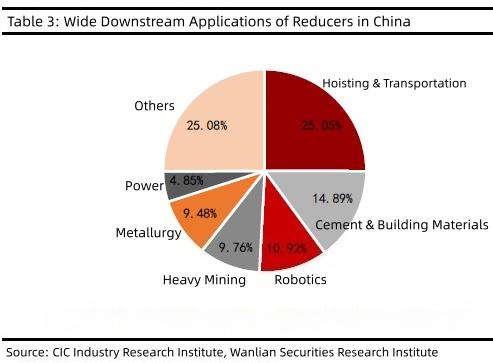
The downstream applications of reducers cover numerous industries and play a crucial role. With their excellent load-bearing capacity, reliability, durability, and precise control over speed and torque, reducers are key to enhancing the efficiency of entire production systems across various industries. Their downstream applications primarily include lifting and transportation, cement and building materials, robotics, heavy mining, metallurgy, and power generation, among other sectors of the national economy and defense industry. Among these, lifting and transportation, cement and building materials, and robotics are the most core application fields for reducers. With China’s sustained economic growth and the deepening of industrial automation, the gross domestic product and fixed asset investment have been rising year by year. As a key basic component of industrial equipment, the market demand for reducers has also been steadily increasing
1.2 Reducers can be classified into three categories: general-purpose, special-purpose, and precision.
Reducers are categorized into three main types: general-purpose reducers, specialized reducers, and precision reducers. Generally speaking, general-purpose reducers are widely applicable, specialized reducers are custom-designed for specific needs, while precision reducers focus on delivering high-precision motion control and positioning capabilities.
General-purpose reducers are standard transmission devices primarily designed for medium and small-scale applications. Widely used in industrial gearboxes, conveyor systems, and related sectors, they offer limited control precision, meeting only the basic power transmission needs of most machinery. Leading manufacturers include SEW, Siemens, Guomao Co., Ltd., Ningbo Dongli, Jiangsu Tailong, and Zhongda Lide.
Specialized reducers: Customized speed reduction devices developed according to specific industrial needs, typically in large or extra-large specifications, can be optimized for specific application scenarios or industry requirements to meet higher performance standards and special functional needs, such as wind power generation gearboxes, metallurgical gearboxes, etc. Representative companies include China High-Speed Transmission, Hangchi Forward, Weili Transmission, Zhongchi, Jinlei Co., Ltd., etc.
Precision reducers, featuring low backlash, high accuracy, long service life, and exceptional reliability, are the preferred choice for precision-critical applications such as robotics and high-end machine tools. Leading manufacturers include HAMERNAK, Nabtesco, Lüde Harmonic, and Zhongda Lide.
Figure 4: Reducers are classified into general-purpose, specialized, and precision types.
level
characteristic
on behalf of company
general reducer
Primarily designed for small and medium-sized applications, these modular and serialized units are widely applicable across various industries.
SEW, Siemens, Guomao Co., Ltd., Ningbo Dongli, Jiangsu Tailong, Zhongda Lide, and others
special reducer
Specifications are primarily large and extra-large, mostly non-standard and industry-specific products.
China reports on high-speed transmission, Hangchi Forward, Weili Transmission, Heavy Teeth, Jinlei Shares
precision speed reduction device
With low return clearance, high precision, long service life, and reliable stability, it is widely used in high-end fields such as robotics and CNC machine tools.
Hamernak, Nabotsk, Green Harmonics, Zhongda Lide, etc.
Source: Guomao Co., Ltd. prospectus, Wanlian Securities Research Institute
Depending on their structure and transmission methods, precision reducers can be classified into harmonic reducers, RV reducers, and precision planetary reducers.
① Harmonic reducer: Composed of a wave generator, flexible gear, and rigid gear. With advantages such as compact size, lightweight design, high transmission accuracy, smooth operation, and large transmission ratio, it is particularly suitable for industrial robots and humanoid robots in industries like 3C, semiconductors, and medical devices. It is mainly used in components like robotic arms, wrists, and hands. However, its drawbacks include low torque transmission, inefficient power transfer, and limited service life.
② RV Reducer: This two-stage mechanism combines involute planetary gear transmission with cycloidal pinion planetary transmission. Featuring high transmission efficiency, smooth operation, strong load-bearing capacity, excellent rigidity, and superior overload impact resistance, it is widely used in heavy-load components of industrial robots such as bases, arms, and shoulders. However, its drawbacks include complex structure, high manufacturing difficulty, and elevated costs.
③ Precision planetary gear reducer: compact in size, composed of planetary gears, sun gear and internal gear ring, with compact structure, high torque, high efficiency of single-stage transmission, light weight, long life and maintenance-free, etc. It is mostly used in the body rotation joints of robots with low precision requirements. Its limitation is the small range of single-stage transmission ratio.
Figure 5: Comparison of Three Precision Reducers
reducer category
design feature
merit
shortcoming
application area
diagrammatic sketch
harmonic reducer
The main components are the wave generator, flexible cabin and rigid cabin. When the reducer operates, the wave generator undergoes controllable deformation, and the power is transmitted through the meshing of the flexible and rigid cabins.
High transmission accuracy, small weight and volume, smooth operation, large transmission ratio
The torque transfer is relatively small, the transmission efficiency is low, and the service life is limited
Joints in robots with lighter loads, such as the forearm, wrist, and hand, are used in fields like aerospace, precision machining equipment, and medical devices.
RV decelerator
It mainly includes two kinds of transmission devices, which are involute planetary gear transmission and cycloidal pinwheel planetary transmission.
The transmission precision is high, the transmission efficiency is high, the transmission stability is high, the bearing capacity is strong, the rigidity and overload impact performance is good.
Complex structure, difficult to manufacture, high cost, and limited service life
The robot has heavy bases, large joints such as the arm and shoulder
precision planetary reducer
The compact design mainly includes planetary gears, sun gears, and internal gear rings. Precision planetary reducers typically have a single-stage reduction ratio of 10 or less, with the number of reduction stages generally not exceeding three.
Single-stage transmission with 97% efficiency, lightweight design, and a service life of up to 20,000 hours—maintenance-free.
The single-stage transmission has a narrow range of transmission ratios.
Precision transmission systems for mobile robots, new energy equipment, high-end machine tools, and intelligent transportation
Source: Kefeng Intelligence IPO prospectus, Wanlian Securities Research Institute
Figure 6: Comparison of Parameters of Three Precision Reducers
Key indicators
harmonic reducer
RV decelerator
precision planetary reducer
transmission efficiency
>70%
>80%
>95%
transmission accuracy
≤60
≤60
≤180
transmission ratio
30-160
30-192.4
3-512
designed life (h)
>8,000
>6,000
>20,000
torsional stiffness
(N·m/arc min)
1.34-54.09
20-1,176
10-370
rated output torque
(N·m)
6.6-921
101-6,135
40-1,200
noise (db)
≤60
≤70
≤65
temperature rise (℃)
≤40
≤45
≤30
Source: Kefeng Intelligence IPO prospectus, Wanlian Securities Research Institute